
💥Sleep Number's Sweet Dreams💥
Plus: Multi-Color Corp. closes out.
See, y’all, this 👇 is the kind of thing we’ve been talking about.
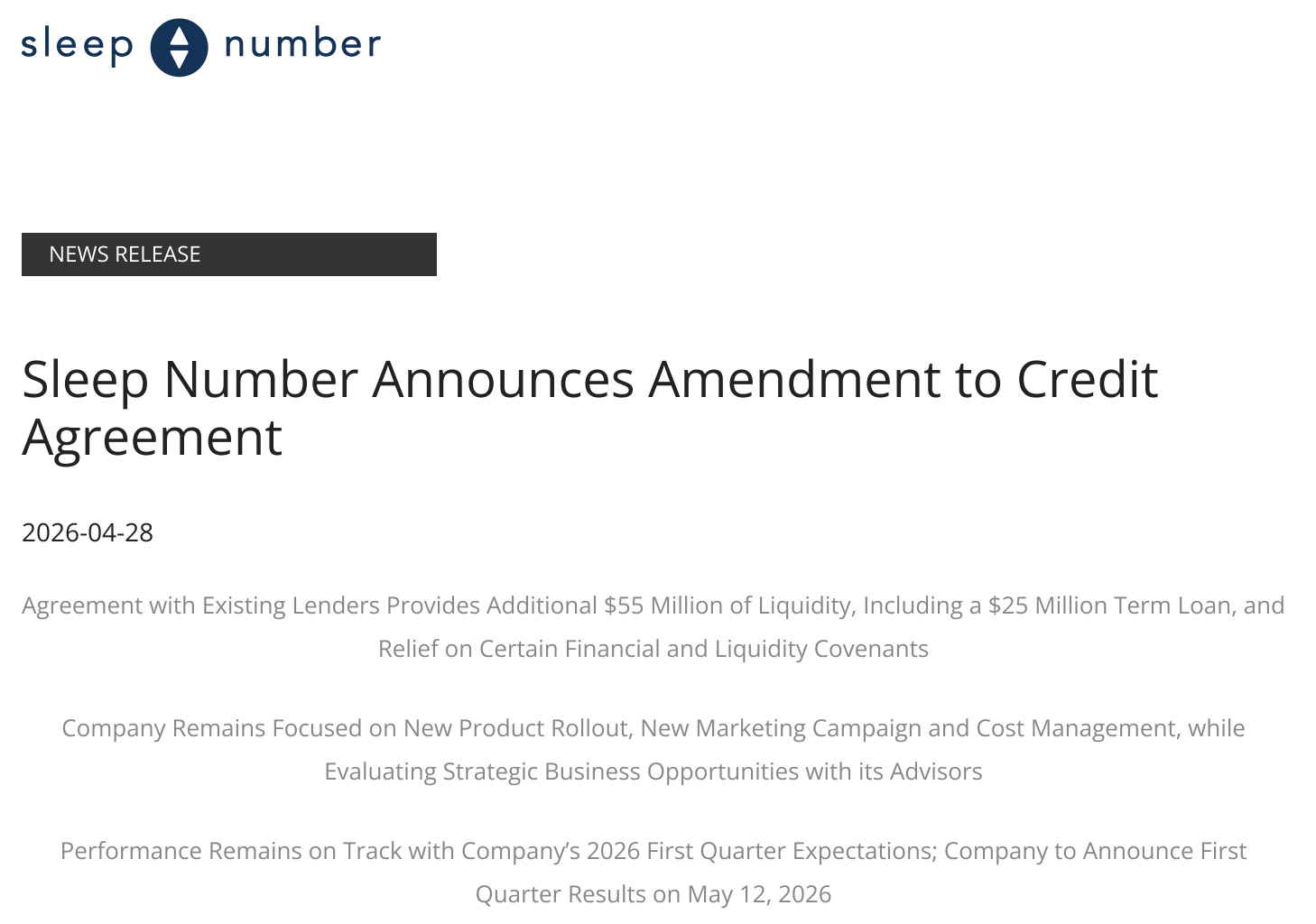
Lenders need to stop doing this sh*t. Lawyers need to stop doing this sh*t. How in hell are we all supposed to afford this Spring’s charity shakedown circuit if we don’t have chapter 11 filings filling coffers with cold hard administrative expense cash?!?
😔
As regular PETITION readers know, we’ve been keenly tracking the performance of, and news surrounding, Sleep Number Corp. ($SNBR)(the “company”) for quite some time now.
Because, mostly, it’s all been bad. We won’t bore you with repetition: you can go back and read the prior coverage 👆.
And so it surely comes as a great relief to the company that it was able to get a (short-term) deal done by way of a forbearance agreement and (thirteenth) credit agreement amendment with its lenders,* buying itself time to “…rollout … its new product portfolio and marketing campaign,” which, we have to assume, will heavily involve this absolute studmuffin:
So what are the details? The amendment:
📍Adds a $25mm term loan facility (the “2026 Term Loan”) that accrues interest at a rate per annum equal to the one-month term SOFR rate plus 8% and matures on June 30, 2026, with a $5mm amortization payment due on June 1, 2026. Note that the 1-month SOFR is ~3.65% as of the time of this writing, making for 11.65% interest.**
📍Gets lenders to back the eff off of exercising any rights in remedies relating to specified events of default (subject to certain forbearance termination events) — which, here, relate to breaches of, among other things, net leverage ratio, interest coverage ratio, and minimum consolidated adjusted EBITDA requirements.
📍Requires “at least monthly” cash interest payments on all loans outstanding under the credit agreement.
📍Allows the company to sell its claim for certain tariff refunds (🤔) and, related, requires mandatory prepayments of the loans outstanding under the credit agreement with any proceeds received from certain asset sales, equity issuances, debt incurrences, insurance claims or condemnation or similar payments. The company appears eligible for $4,250,000 in refunds.
📍Requires more financial reporting to lenders.
📍Pushes any application of the minimum liquidity financial covenant “…until the last Business Day of the first week ending after July 1, 2026,” and thereafter the company must maintain $30mm from July 1, 2026 through and including October 3, 2026 and, beyond that, maintain $40mm. If you’re wondering how the company arrived at the headline $55mm figure in its press release 👆, this is it: it seems that, in addition to the new $25mm 2026 Term Loan, the company is counting the $30mm minimum liquidity adjustment.
📍Places limitations on new draws under the revolving credit facility outstanding under the credit agreement.
📍Imposes milestones for the company to consummate a strategic transaction that maximizes enterprise value and provides for payment in full of obligations due under the credit agreement.
The stock market reacted very favorably to the news — at one point reaching as high as $4.16/share before coming back down to earth a bit.
Look closely and you may even realize that, at this price, the stock has merely clawed back to slightly below where it was — $3.31/share — when we last wrote about it in March. So 🤷♀️.
Does all of this mean that the company is out of the woods? No, we wouldn’t quite say that. Not to state the obvious but it has to execute on its business plan; it has to make sure consumers turn out for its products over the next several months. That means the company must take advantage of critical mattress-buying holidays, e.g., Memorial Day and July 4th. In other words, a lot of high-end customers benefitting from the K-shaped economy — these beds ain’t cheap — will need to free themselves from the tyranny of insomnia for this company to continue staving off a chapter 11 bankruptcy filing. Otherwise, absent some “strategic transaction,” we’re ultimately looking at an equitization of the growing amount of debt issued under the credit agreement (or a sale in chapter).
The goods news is that we’ll get some indication of how management is converting soon. Q1’26 earnings come out on May 12, 2026.
Management says performance remains “on track” with (its previously lowered) expectations.
We. Shall. See.
*Lenders include U.S. Bank NA, Keybank NA, BMO Bank NA, Bank of America NA, PNC Bank NA, Associated Bank NA, Capital One NA, Huntington National Bank, Citizens Bank NA.
**In addition to the $25mm 2026 Term Loan, the company drew down $2.7mm of revolving loans such that the revolver now has $447.2mm outstanding.
⚡Update 2: Multi-Color Corporation⚡
What a wild a$$ ride the not-prepackaged “prepackaged” chapter 11 cases of Multi-Color Corporation (“MCC”), MCC-Norwood, LLC (“MCC Norwood”), and their fifty-four affiliates (collectively, together with MCC and MCC Norwood, the “debtors” and together with their non-debtor subsidiaries, the “company”) have been. The cases filed in January ‘26 in the District of New Jersey (Judge Kaplan), and you can read our prior coverage 👇:
The basic premise of the “prepack” among the debtors, repped by Kirkland & Ellis LLP (“K&E”), their secured ad hoc group, repped by Milbank LLP, and sponsor Clayton, Dubilier & Rice, LLC (“CD&R”), repped by Latham & Watkins LLP was to take this debt …

… and restructure it by (i) paying off ABL claims in full, (ii) paying first lien secured claims 81.6-98.4% through $200mm in cash, ~$1.6b in takeback debt, 13.3% in reorg equity, $62.1mm in pref equity, the right to subscribe to additional pref equity, and warrants, (iii) paying junior funded debt claims, including 1L deficiency claims — which were lumped into class 5 alongside unsecured note claims (PETITION Note: That’s important for below) — 2.6-2.8% through $57.5mm in cash and 5% of reorg equity, (iv) passing GUCs all the way through.
Oh, and letting CD&R stay in the game by ponying up $400mm in exchange for 64% of the reorg equity plus other goodies.
Enter Jones Day’s Bruce Bennett, who on behalf of a crossholder ad hoc group, chimed in:
He pitched a fit about everything.* Venue. His group’s much superior DIP. The insidery-as-f*ck plan. All but the last of which precipitated appeals because Judge Kaplan was never not going to give the debtors everything they asked for.** The last one would’ve been the subject of an appeal too buuuuutttttttt …
… that sh*t is all in the past.*** After Joseph Greenaway, Jr. tried and failed to mediate an outcome, on March 31, 2026, Judge Kaplan saw fit to take matters into his own hands and appoint himself as mediator. Here’s a live shot of the cases’ presiding judge making that call:
*Sigh* — of course not. There’s definitely no issue with moving what would’ve otherwise been public matters to behind closed doors. Definitely doesn’t undermine the integrity of the bankruptcy system, 🙄.
LOL, as if that matters. Y’all read the venue coverage, right?
Anyway, do you see any problems with a judge-mediator combo, Shumaker, Loop & Kendrick LLP’s Steven Berman? Per Bloomberg:
“If I’m going to be sharing something and really exposing problems on my side or my strategy moving forward, I would be hesitant to share that with the presiding judge.”
No sh*t, makes perfect sense. What about you, former bankruptcy judge and current law professor Bruce Markell? From the same article:
“If the mediation fails, what does the judge do with what they’ve learned that would not be admissible in court? … It’s not like Men in Black where someone can flash a device and erase the memories.”
Another good point!
Regardless of that million reasons why it shouldn’t happen … that’s what happened. Judge Kaplan shrugged off skepticism and told parties how he’d rule hammered out an outcome, which became, you know, public on April 15, 2026, aka the rescheduled date of the debtors’ confirmation hearing. Here’s K&E with a summary of the settlement at the April 15 hearing:
“Class 5 cash consideration of $57.5 million and the 5% new common equity distribution remains unchanged. Through the plan settlement, Class 5 claimants are now also receiving warrants for 5% of reorganized equity and $25 million of take-back debt. The debtors’ first lien creditors have collectively agreed to waive 50% of their first lien deficiency claims, and consenting stakeholders have agreed to cap their recovery on account of their respective unsecured notes at the pre-settlement level, essentially allocating the benefit of the deficiency claim waiver to the non-RSA unsecured note holders. The consenting stakeholders have also agreed to waive the recovery on account of the 5% Series B new warrants and the $25 million of take-back debt … I did want to highlight as part of the settlement, the debtors have agreed to pay up to $19.5 million to the crossholder group’s fees and expenses.”
That’s not all either. Recall that the crossholder ad hoc group had been powered by Canyon Capital Advisors LLC (“Canyon”). They got their own goodies. Back to K&E:
“And with respect to the Canyon parties, backstop parties have agreed to contribute $2.5 million of cash and the plan sponsor will contribute $1 million of take-back debt. Those are coming from their recoveries under the plan. And then in connection with the plan settlement, the crossholder group and the plan sponsor have entered into a separate settlement and release agreement in exchange for $17 million of cash to be paid by the plan sponsor to the crossholder group.”
A satisfying conclusion to the cases?
We had been looking forward to the reversal of the venue decision.
But we understand why the crossholder group cut a deal too.
So, after delaying the confirmation hearing one day on account of the debtors’ dropping 1k+ pages of paper on the docket overnight, on April 16, 2025, the court quickly disposed of the US trustee’s objection (to opt-out releases and the plan’s gatekeeper provisions) and entered the confirmation order.
The plan is expected to go effective in the next week or so, and therefore, we won’t be coming back to the debtors. 🫡, Mr. Bennett.
*An “excluded first lien lender” group, represented by Willkie Farr & Gallagher LLP, objected too. But let’s not kid ourselves, Mr. Bennett was the heavy hitter.
**Well, except on the final DIP. Kinda. On March 26, 2026, he ruled that he would defer ruling on its final $125mm roll-up of prepetition debt until the confirmation hearing. That didn’t work for the secured ad hoc group, so the next morning, the debtors came back and asked for $62.5mm (i.e., half) of the new money funding for a commensurate roll-up. Judge Kaplan was good with that, 🤷.
***The debtors also filed a motion to disband the official committee of unsecured creditors. The UCC and the US trustee objected (here and here), but Judge Kaplan never had to address it — it too settled in mediation.
📚Resources📚
We have compiled a list of a$$-kicking resources on the topics of restructuring, tech, finance, investing, and disruption. 💥You can find it here💥.
📤 Notice📤
Amanda Simone (Associate) joined Connell Foley from FBT Gibbons.
Kyle McEvilly (Associate) joined Connell Foley from FBT Gibbons.
🍾Congratulations to…🍾
Stephen Lerner, Partner and Global Chair of the Restructuring & Insolvency Practice Group at Squire Patton Boggs, on his ascension to President of the American Bankruptcy Institute.
Stinson LLP (Edwin Caldie, Andrew Glasnovich, Logan Kugler) for securing the legal mandate on behalf of the official committee of unsecured creditors in the Catholic Diocese of El Paso chapter 11 bankruptcy case.


