

💥Is Hain in Pain?💥
Plus: a Sweetgreen, Inc. ($SG) update.
We don’t know about y’all but we’ll take a hard pass on salads and just sustain ourselves on steak and protein bars for the time being.
With that in mind, let’s dive in to some food situations that’ve caught our attention of late. You can take comfort in knowing that you can consume this content without catching “explosive diarrhea.”
🥬Sweetgreen = Gutted?🥬
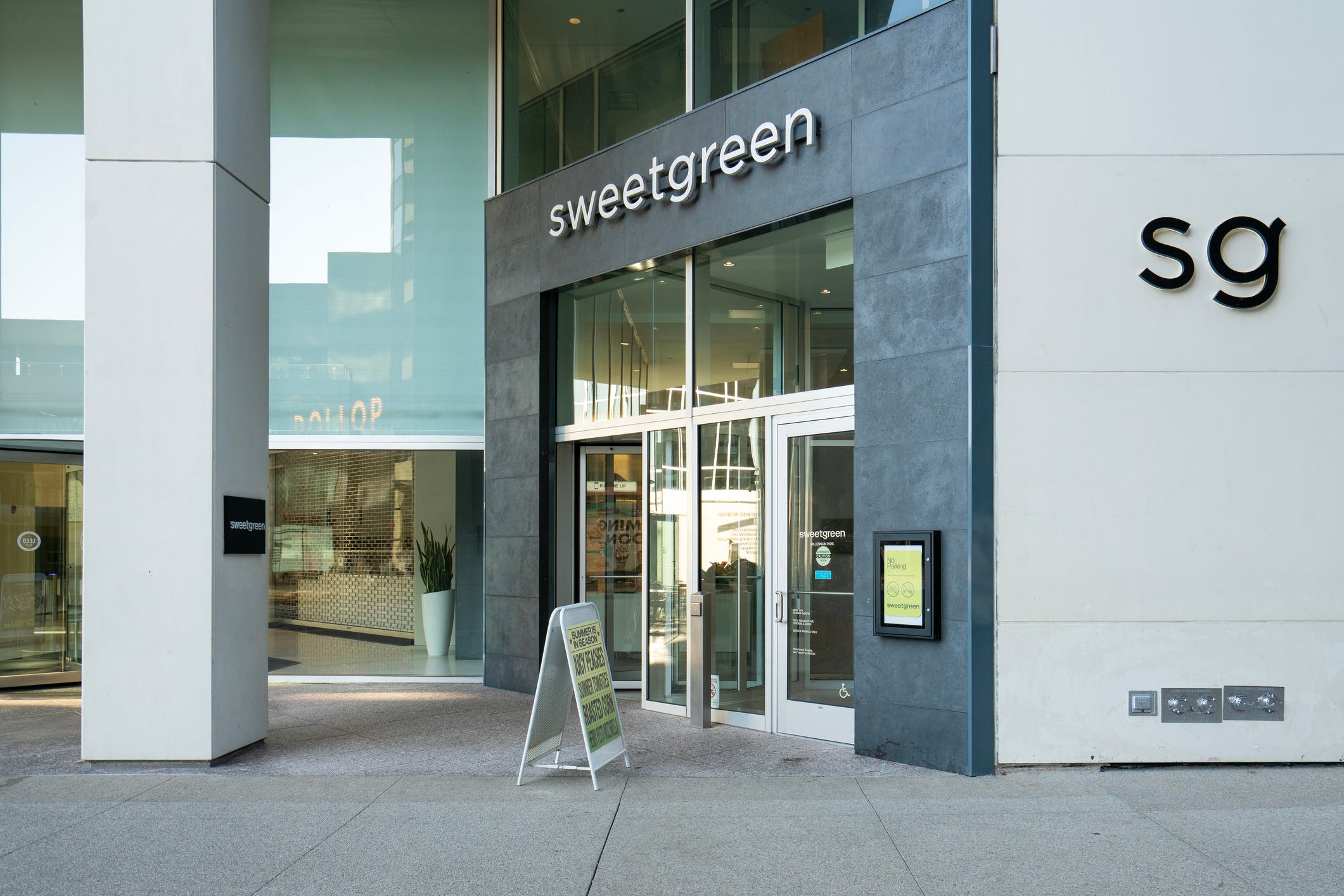
We’ve been massacring covering Sweetgreen, Inc. ($SG)(“Sweetgreen” or the “company”) since it IPO’d back in ’21 …

… and we last talked about it a few weeks ago when the FDA and CDC announced that it was Taylor Fresh Foods, Inc. (“Taylor Farms”) and Taco Bell, part of Yum! Brands Inc ($YUM), that were responsible for serving up explosive diarrhea parasites (“cyclospora”) to the American public — and not Sweetgreen.

The company’s stock jumped 15% on the news.
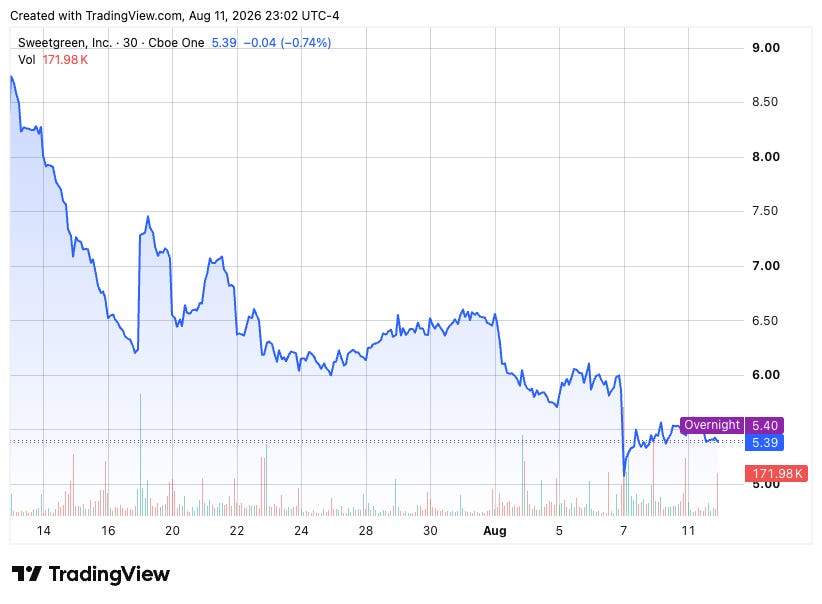
But, as you can see 👆, it didn’t last. We wrote:*
“The stock initially regained more ground only to reverse course and re-cede 5%. Why? Presumably because investors remembered that the company’s earnings have been and likely will be explosive diarrhea.”
We went on to discuss the company’s last reported quarter, adding:
“In its most recent reported quarter — fiscal Q1’26 reported back in early May — the company reported $161.5mm of revenue, 2.9% YOY decrease; its same store sales declined 12.8% on an 11.2% drop in guest traffic and a 2.3% dip in product mix. Net income increased to $125.8mm from a new loss of $25mm in the corresponding ‘25 quarter but that was due entirely to a one-time gain on the sale of a subsidiary, lol. The company’s loss from operations widened by nearly $6mm; its restaurant level profit margin compressed by nearly 800 basis points(!) down to 10% and its adjusted EBITDA swung to a $8.1mm loss (compared to a $0.3mm gain in Q1’25).”
We concluded:
“The company reports Q2’26 earnings on August 6, 2026 but the explosive diarrhea parasite won’t show up in there for obvious timing reasons. We do wonder, however, what management will say about its impact.
The bottom line? This is not an RX opportunity currently but this sh*t stain of a company needed an explosive diarrhea parasite like Johnny needs a hole in the head. We will gleefully continue to watch its performance dive into the sh*tter.”
Well, we now, as of August 6, 2026, have the benefit of those Q2’26 earnings for the 13-week period ended June 28, 2026 — which, uh, is an obviously VERY significant marker.
How’d the company do? Well, management was pretty upbeat, actually. CFO Jamie McConnell had this to say on the 2Q26 earnings call:
“The progress we saw during the second quarter and into early July reinforces our confidence in the underlying direction of the business. We will continue to move with urgency as we position Sweetgreen for more consistent and profitable growth over time.”
Co-Founder and CEO Jonathan Neman later added:
“Before Cyclospora hit, we were seeing a really nice momentum in, let’s call it, the first 10 days of July with positive comps and transactions.”
To the numbers!
📍Total revenue came in at $192.7mm, a 19% sequential rise and up nearly 4% on a YOY basis;
📍Same store sales were down 6.2% YOY — bad, but an improvement over Q1’26 and Q2’25’s comp;
📍Net income was negative $26.3mm, a continuing downward trend.
During 1H’26, same-store sales declined 6% YOY, while total revenue was basically flat despite six net new store openings. The declines were entirely driven by mix and volume, as the company has not been able to push pricing on its already overpriced salads in over a year, according to Neman.
“We have not taken a price increase in over a year, and since 2019, our price increases have trailed broader restaurant industry inflation by more than 13 percentage points and grocery inflation by more than seven percentage points.”
2Q26 Adjusted EBITDA was just below zero at ($0.2mm) with a (0.1%) margin, vs. $6.4mm and a 3.5% margin in the prior year. For 1H26, Adj. EBITDA improved to $7mm and a positive 1.9% margin, vs. ($8mm) and a negative (2.3%) margin in the prior year period
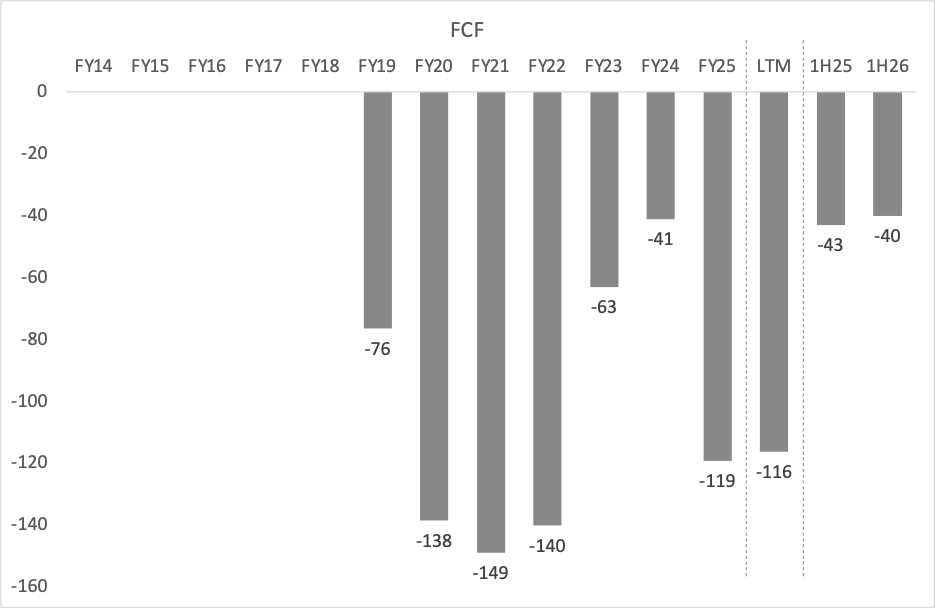
Cash keeps flowing out of the business. FCF was ($40mm) in 1H’26 vs. ($43mm) in 1H’25. We guess you can chalk that up as an improvement too, though, 🤷♀️.
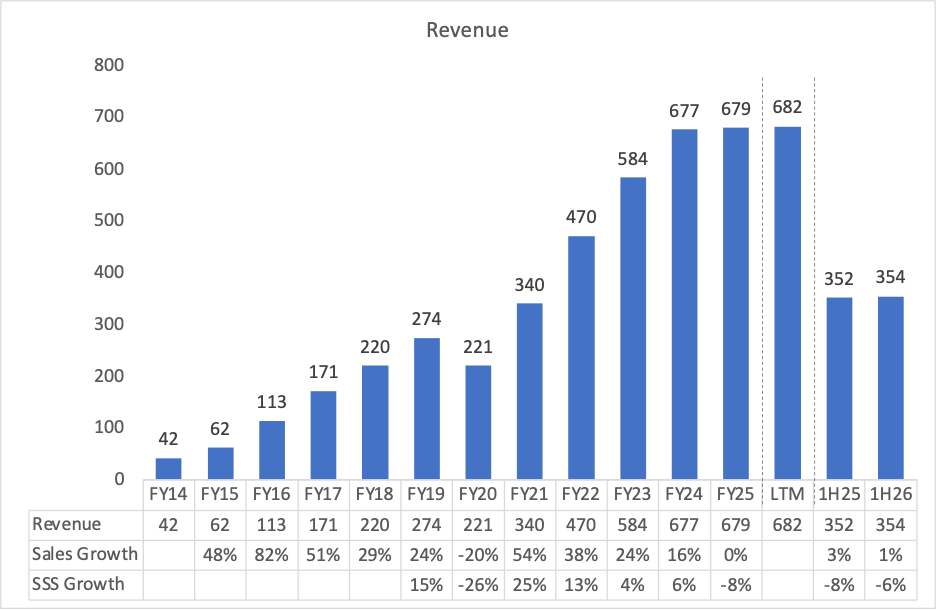
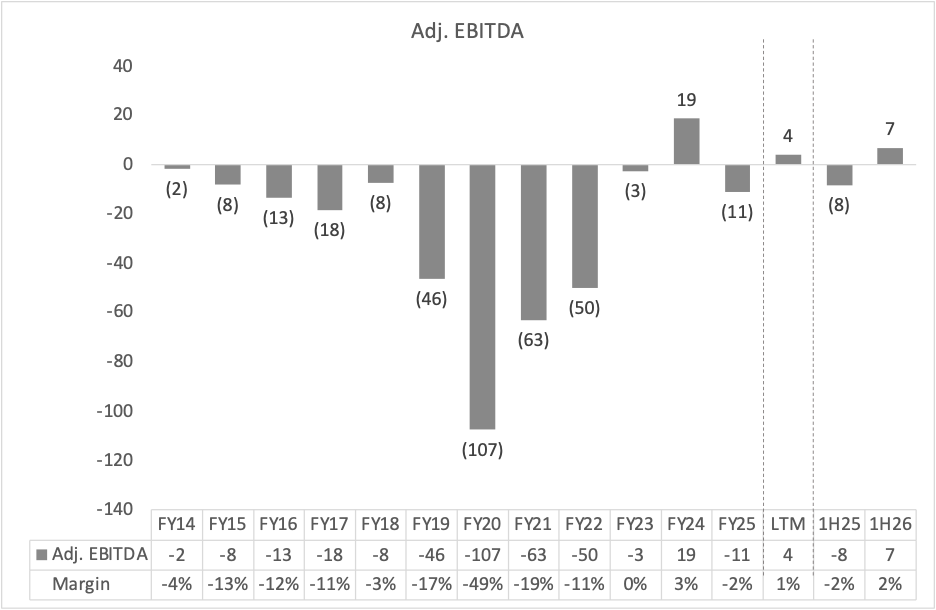
Of course, it’s next quarter where the rubber will meet the road: cyclospora only started to grab headlines in early July.
In light of the outbreak, Sweetgreen revised its 2026 outlook:
📍Approximately 13 net new restaurant openings (unchanged);
📍Same-Store Sales Change between (7-8%) vs. prior guidance of (2-4%);
📍Restaurant-Level Profit Margins of 10.5-11% vs. prior guidance of 14.2-14.7%; and
📍Adjusted EBITDA between ($23-27mm) vs. prior guidance of $1-6mm.
On the earnings call, Neman also announced that Sweetgreen had removed and discarded all of its jalapeños after the supplier had voluntarily recalled them. That supplier? Once again, Taylor Farms (this time recalling all its jalapeños after a salmonella outbreak).
The company ended the quarter with $143mm of cash on hand; it has no debt since its revolver expired in ’24 without replacement. The company has never been FCF positive and yet intends to fund itself through a combination of available cash and cash flow from operations. We would think that the company’s FCF figure in Q3’26 will be abysmal but, per our footnote ⬇️, we really don’t f*cking know anything anymore: sh*t be cray cray out there.
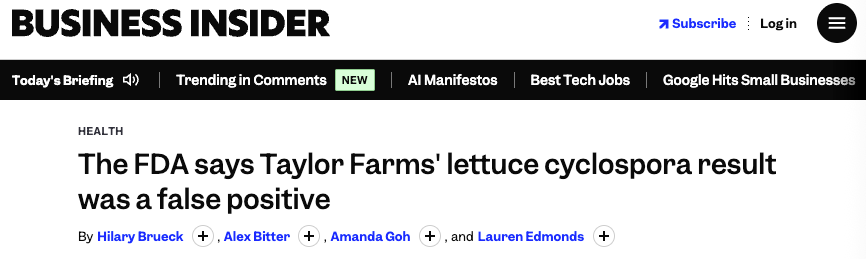
*Obviously there’s an information dislocation too. Consumers aren’t able to discern where lettuce comes from and, in turn, what may or may not be contaminated. And headlines like this don’t help:
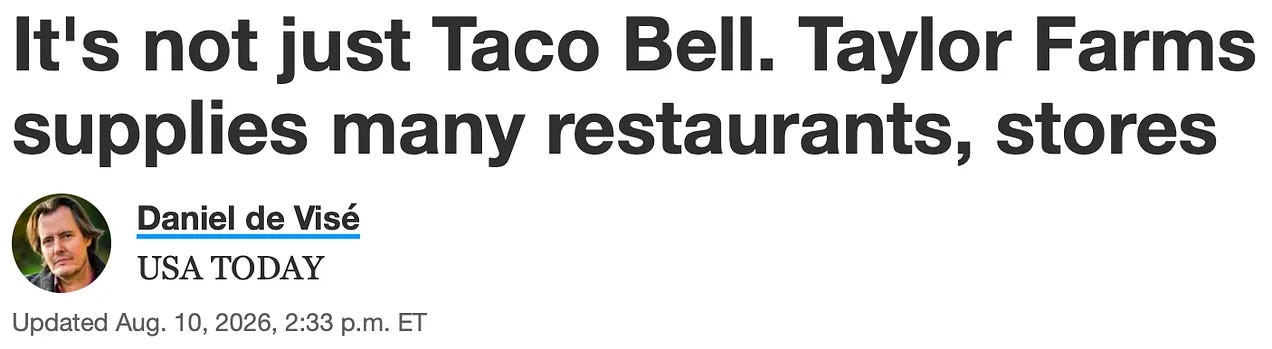
Or this:
Johnny did, however, walk past a Sweetgreen location this past weekend and much to his surprise, the outdoor seating area was teeming. In, like, 95 degree weather. Are people just blissfully ignorant? Seeking a weight-loss alternative to GLP-1s? Channeling the Tide Pod era and intentionally subjecting themselves to cyclospora for clicks and giggles? Seriously, y’all, wtf is going on out there?!
⏩ One to Watch: The Hain Celestial Group ($HAIN) ⏩
While we’re on the topic of food ….
The Hain Celestial Group, Inc. ($HAIN)(“Hain” or the “company”) is the Hoboken, NJ-based maker of organic and natural food, beverage, and personal care products; it sells “better-for-you” snacks, baby/kids food, beverages, and meal prep under a variety of brand names in 70 countries across the world. Trust us when we tell you there isn’t much left in the portfolio that you’ve likely heard of, though, until recently, Hain was the company behind several snacks likely to have made an appearance in your office pantry—Terra, Garden Veggie, and, lol, Garden of Eatin’.
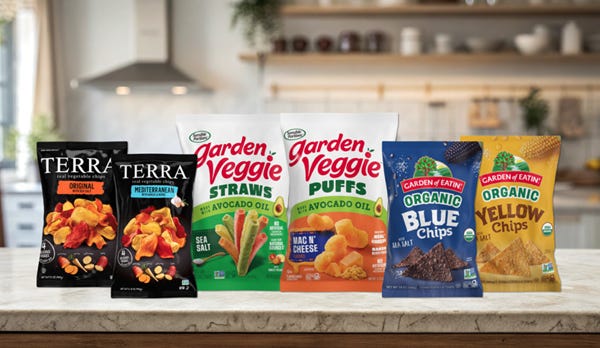
In FY25 (ended 6/30/25), the company’s $1.6bn of sales were split:
📍Snacks: 24% of net sales, $371mm;
📍Meal prep: 41%, $639mm;
📍Beverages: 16%, $245mm;
📍Baby & kids: 15%, $242mm; and
📍Personal care: 4%, $62mm.
57% of these sales came from the North America segment, and the remaining 43% were International (mainly the U.K. and Western Europe).
Like many food & beverage companies – including a few that’ve recently graced bankruptcy dockets (cough Republic National Distributing Company LLC) – Hain is getting its a$$ kicked by GLP-1s, because, put plainly, people ain’t snackin’ like they used to.
The company’s problems, however, are deeper and extend back to a time before GLP-1s sucked all of the fun (and pounds) out of your fat f*ck friends. Indeed, sales have been declining for years. In fact, you’d have to go all the way back to ’18 to find a year where Hain’s sales increased on an organic basis.
Let’s back up. The company was founded in ’93 and became public in ’97 after acquiring and merging into another natural foods company, Westbrae Natural, Inc. The company continued to grow through acquisitions, gobbling up other natural foods brands until net sales peaked at $2.8b in ’16.
With growth slowing in ’16, the company launched a strategic review process dubbed “Project Terra” to simplify the Frankenstein’s monster of a business it had created through so many acquisitions.
In ’18, Engaged Capital ramped up pressure on the company, ultimately joining the Board and pushing Founder and then-CEO Irwin Simon out. That same year, the divestitures and discontinuations began, and sales have declined every year since.
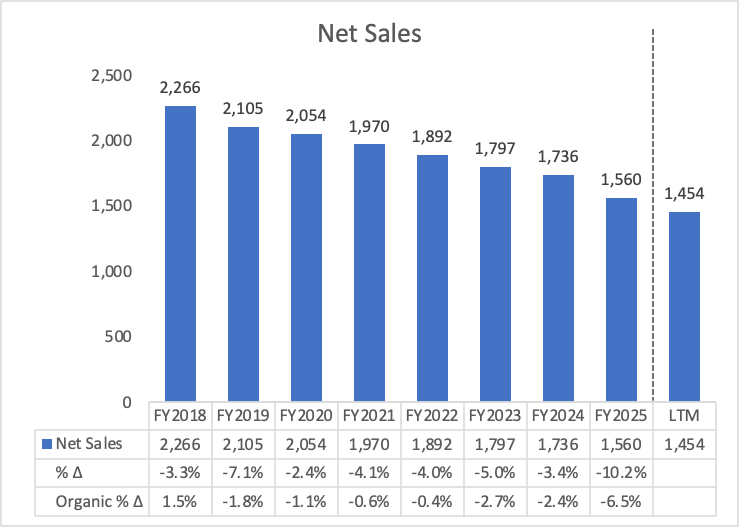
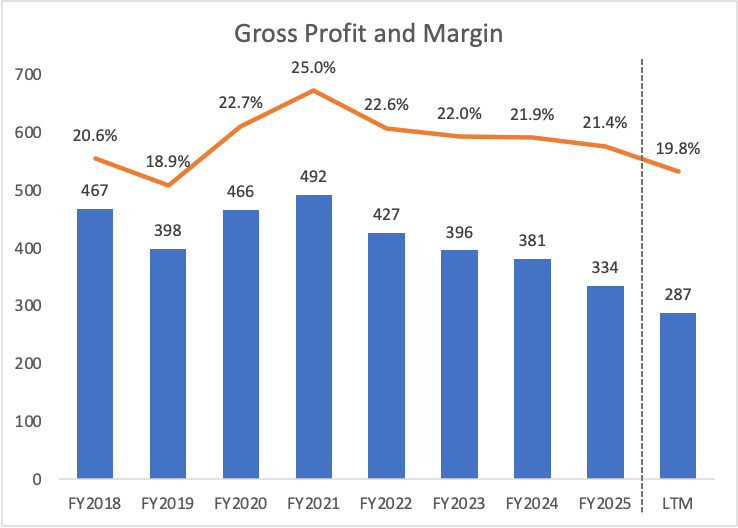
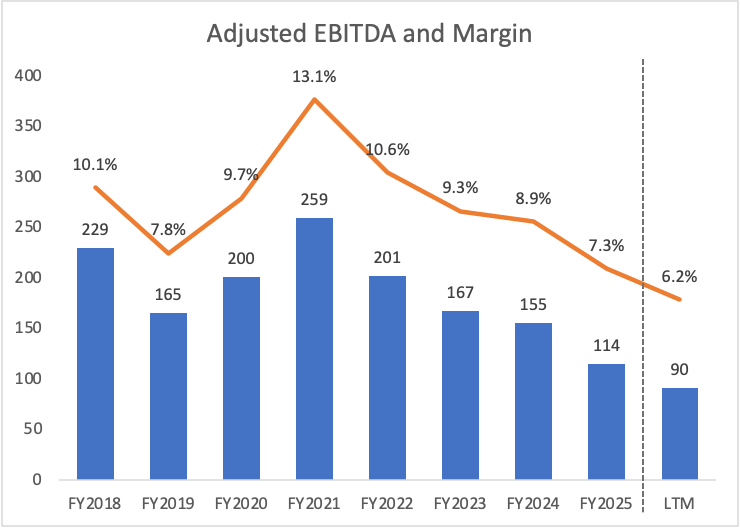
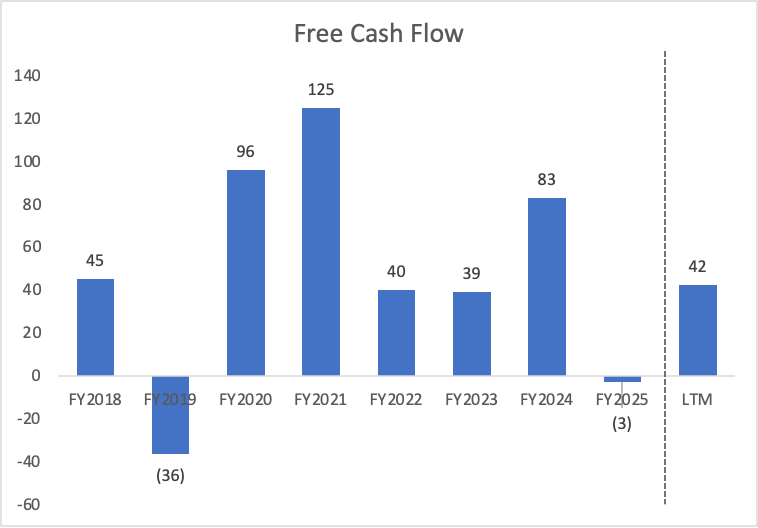
The divestitures and discontinuations of lower margin SKUs, combined with other cost saving initiatives, meant that margins and FCF peaked later, in ’21.
In ’22, inflationary pressures began to hamstring the company in several ways: first, the company’s costs increased across the board – ingredients, packaging, energy, transport, all went up. These costs could not be fully passed on to customers, who, subjected to the same inflationary pressures, began to trade down from the company’s relatively expensive organic, natural foods to lower-priced products. Then, finally, as we all know, inflationary pressures pushed up interest rates, making it challenging for the company to service its debt at the same time it was struggling operationally.
Hain replaced its CEO Mark Schiller in ’22, with Wendy Davidson, who was then replaced in ’25 by current CEO Alison Lewis.
This succession of CEOs has launched restructuring plan after restructuring plan. The latest, “Hain Reimagined” program, began in 1Q24 and has so far cost $108mm. The company expects to fully complete the program by the end of ’27 at a cumulative cost (which has continued to grow) of $115-125mm. Hain expects its actions to generate $130-150mm in cost savings. Despite all these initiatives, gross margins and Adj. EBITDA margins are at decade-plus lows.
Facing a December ’26 maturity wall and a going concern warning, the company engaged Goldman Sachs & Co. ($GS) to assist with a strategic review in May ’25, at the same time that new CEO Alison Lewis took the helm.
That process is ongoing, but has so far resulted in the company selling off its North American snacks business to Snackruptors for $115mm cash.* The snacks business represented 22% of net sales in FY25 but had a “negligible EBITDA contribution” over the last twelve months. Net proceeds from the transaction, which closed in February ’26, totaled $101mm and were used to pay down debt.
Hain described the transaction as “...represent[ing] an important first step in the Company’s broader strategic review, as it reduced leverage while enabling the Company to focus on a more concentrated portfolio of core assets to drive growth.”
The debt pay-down leaves the company with the following capital structure as of 3/31/2026:
📍$401mm outstanding under a $600mm senior secured revolver due December 22, 2026.📍$149mm outstanding under a senior secured term loan also due December 22, 2026.
The revolver and the term loan are governed by the same credit agreement, which has now been amended four times, including two amendments in the last year to grant covenant relief (Bank of America, N.A. ($BAC) is agent.) Following the latest/fourth amendment, the loans bear interest at a rate of S+400bps (vs. S+250bps at issuance in ’21) and the revolver capacity has been reduced to $600mm (vs. $800mm at issuance).
The company is now also subject to three maintenance covenants (i) maximum consolidated secured net leverage < 5.5x, (ii) maximum consolidated net leverage < 6.0x, and (iii) minimum consolidated interest coverage > 2.0x. Hain was in compliance with all covenants as of March ’26. It ended the quarter with $44mm of cash and $195mm available under its revolver subject to the above covenants.
The stock is near all-time lows and hasn’t traded above $1 since February ’26.
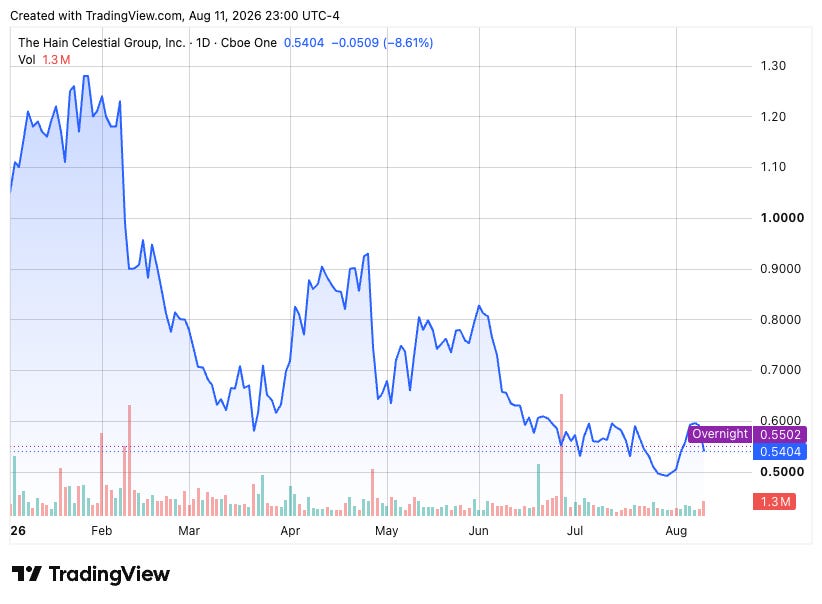
The company has historically reported its 4Q earnings between late August and mid-September. Beyond that, there will surely be more news to come as the December maturities grow ever nearer.
*Goldman Sachs & Co. LLC served as financial advisor to Hain and Cravath, Swaine & Moore LLP served as legal counsel. We’d be willing to bed the farm that there’s a new slate of professionals in there these days, 😉.
📚Resources📚

There’s a lot of jittery market activity out there so you’ll have to forgive us for having market dysfunction on our minds. As you know, we’ve had a long-standing list of a$$-kicking resources on the topics of restructuring, tech, finance, investing, and disruption which, in case you forgot,💥you can find here💥. We do occasionally update it and this week you’ll now find a number of titles we’ve been dabbling in related to financial bubbles/crises. Take a look and read until your heart’s discontent.
🍾Congratulations to…🍾
Alvarez & Marsal North America, LLC (Mark Greenberg) for securing the financial advisor mandate on behalf of the official committee of unsecured creditors in the Searles Valley Minerals, Inc. chapter 11 bankruptcy cases.
Brown Rudnick LLP (Bennett Silverberg, Tristan Axelrod, Jessica Liong, Matthew Davis) for securing the legal mandate on behalf of the official committee of unsecured creditors in the SynergenX Legacy Holdings, LLC chapter 11 bankruptcy cases.
Dundon Advisors LLC (Matthew Dundon) for securing the financial advisor mandate on behalf of the official committee of unsecured creditors in the U.S. TelePacific Corp. chapter 11 bankruptcy cases.
M3 Advisory Partners, LP (Robert Winning) for securing the financial advisor mandate on behalf of the official committee of unsecured creditors in the SIMAD Holdings Ltd. chapter 11 bankruptcy cases.
NOTE: do you have exciting news to share? Feel free to email us — especially if you’re a firm administrator — with any and all personnel news at petition@petition11.com.
💰New Opportunities💰

PETITION is looking for MBA and JD candidates to work with us as paid interns. This is primarily a research and writing position for up to 10-20 hours a week that will give awesome exposure to the worlds of distressed investing, bankruptcy and restructuring. Work is remote. If interested, email us your resume at petition@petition11.com with the subject line “Internship” and we’ll be happy to answer questions. Cheers.
*****
PETITION is also seeking a freelance social media manager to give life to PETITION’s accounts on Instagram and potentially other platforms. The ideal candidate has experience managing social for a media brand or creator, is fluent in Canva and/or Illustrator, can adapt newsletter content into sharp, on-brand social posts (feed, stories, reels), and understands and enjoys financial storytelling. If you’re interested or know someone who could be a great fit, please send your/their portfolio, relevant social handles, and a short note about your/their availability to petition@petition11.com.