
💥Saks of Sh...💥
A Saks Global Enterprises LLC Update + Ascend Elements Inc. files for bankruptcy in Texas
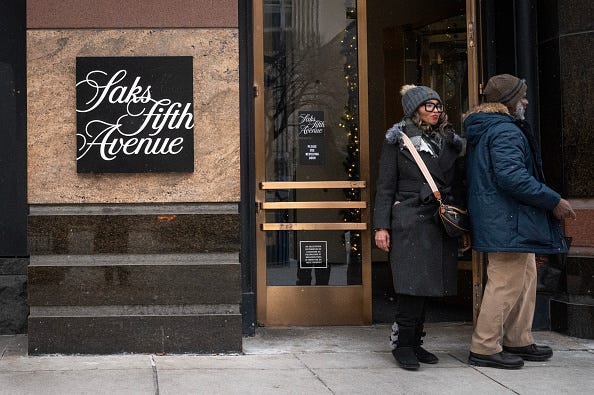
In January ‘26, Saks Global Enterprises, LLC (“SGE”) and 112 affiliates (collectively, with SGE, the “debtors” and together with their non-debtor affiliates, the “company”) filed freefall chapter 11 cases in the Southern District of Texas (Judge Perez). We covered the hotly-contested first-day hearing featuring objecting-party Amazon.com Services LLC ($AMZN) here ⬇️:
The (interesting)* drama, however, didn’t last. Instead, the debtors, represented by Willkie Farr & Gallagher LLP (“Willkie”) and the ad hoc group of noteholders (the “ad hoc group”), represented by Paul, Weiss, Rifkind, Wharton & Garrison LLP, opted for a brokered resolution.
In terms of other objectors, including (i) brands V Opco, LLC and Centric Brands, and (ii) the official committee of unsecured creditors (the “UCC”), repped by Morrison Foerster LLP, the debtors seemingly just gave them everything they wanted…? Or at least that’s what happened on the $1.75b DIP (of which $1b was new money). Per a concise (🙏) February 19, 2026 statement filed by the UCC, we learned — as between the luxury retailer and the suppliers of the, you know, luxury goods they sell — who really drove the bus:
“Saks Global operates a high-end luxury retail business that relies on continued access to the premium brands it carries. The ability of Saks Global to attract customers and generate revenue depends on maintaining the confidence of its brand partners and ensuring a steady flow of high-end merchandise. Fashion houses are not ordinary vendors. They are strategic partners whose brands and reputations are fundamental to the Saks Global business model. Their confidence is not incidental to the business, it is the business.”
And more importantly, what changes suppliers were able to impose on the debtors and the ad hoc group, including — here’s where our non-technical readers can basically just scroll past the “pins” because the upshot is the suppliers did fairly well:
📍A stipulation that “… concession and consignment vendors have valid and perfected rights to goods that are in the Global Debtors’ possession during the bankruptcy cases …” regardless of when delivered and whether the vendor did anything at all to perfect under state law.
📍A non-waiver of surcharge rights as against the ad hoc group.
📍Subordination of the new money and roll-up DIP loans to concession and consignment vendors for each and every postpetition sale. Yeah, you read that right.
📍An agreement from the DIP lenders to marshal away from assets that were unencumbered as of the petition date, including avoidance actions and — the topic of much of the first-day hearing — the value of Saks Fifth Avenue Holdco II LLC, which had supplied vendors with (unsecured) credit support and indirectly owns the company’s flagship store and real estate at 611 Fifth Avenue, NYC.
📍The payment of landlord stub rent claims within ten business days.
With the UCC on board, the final order followed the next day.
After closing eighteen Saks Fifth Avenue and three Neiman Marcus locations in March ‘26, all in accordance with the go-forward plan, on April 2, 2026, the company announced it had entered into a restructuring support agreement (the “RSA”) with the DIP-provisioning ad hoc group.
Well, not all of it.
At an April 10, 2026 hearing, the debtors reported that “… more than two-thirds of the DIP loan signed up to that RSA.” Where’s everybody else?
Not invited? Tired of throwing good money after bad? Guess we’ll have to wait to find out.
Anyway, under the RSA, the signatory lenders committed to providing $500mm of exit financing,** in the form of an as-of-yet-undecided term loan, notes, pref equity, or a combo of the foregoing,*** which will be used to pay off the DIP ABL and provide working capital.
Which begs another question: were any third parties interested at all in providing an exit?
FWIW, we’d guess that’s a “hard no.” For one, because the exit ain’t cheap — on April 9, 2026, the debtors filed a motion for authority to perform under the related commitment letter and pay premiums totaling 17.5% of the commitments (or, you know, ~$37.5mm),**** regardless of whether the facility ever closes.*****
For another, the debtors’ April 5 (unfinished, bracketed to hell) chapter 11 plan and disclosure statement paint an incomplete, yet grim picture. To illustrate, let’s go back to the DIP and, specifically, the SGUS LLC term loan depicted in the second row below:

That’s the $1b in new money and further roll-ups and participations benefiting the ad hoc group. Under the plan, the new money will receive an unknown amount of takeback debt and pref equity, while the roll-ups and participations will get the reorg common (splits TBD) and interests in a litigation trust.
As to claims junior to the DIP (i.e., near everything), it’s is a “[●]” across the board for now, but c’mon, we all know what’s likely in store:
Heck, the debtors are already looking under the seat cushions for spare change, evidenced by the fact that, the very same they, they asked to sell their business jet for a pre-broker-fee $6mm, which Judge Perez approved yesterday. Which, if you’re tracking, ain’t even enough to handle the first 18 days of Willkie’s postpetition billings.******
We should find the official “recoveries” in the near-term. The debtors requested a conditional approval hearing on the DS for April 24, 2026 at 9am CT, to be followed by a combined hearing on June 5, 2026.
*We said “interesting” on purpose. The debtors have been caught up in an adversary proceeding with former employee and pro se litigant Andrei Rus about alleged employment retaliation claims and document preservation issues, which have nothing to do with restructuring and, if we’re being honest, are boring AF. And there had been litigation with Simon Property Group, L.P. about the proper way to read a lease provision (🥱), which is naturally heading toward a settlement.
**Ratcheted down dollar for dollar “… to the extent that the Global Debtors’ projected liquidity on the Plan Effective Date exceeds $700 million.”
***The “majority commitment parties” — two unaffiliated parties holding more than 50% of the commitments — have until May 15, 2026 to decide how it’ll be split up between debt and equity.
****Notably, the premium never ratchets down.
*****Although closing gives the majority commitment parties more options, including reorg common at a 20% discount to plan value. Not closing just means it has to be paid in cash.
******Somebody pour one out for Allyson Smith, who, after following Ryan Bennett over to Willkie, managed to drop 219.1 hours into this dumpster during that time frame for a ~377 hour/month pace (😮💨).
🪫New Chapter 11 Bankruptcy Filing - Ascend Elements Inc.🪫
On April 9, 2026, Massachusetts-based Ascend Elements Inc. and Ascend Elements US LLC (together, the “debtors” and along with a number of mostly-foreign affiliates, the “company”) descended (😉) into chapter 11 bankruptcy case in the Southern District of Texas (Judge Perez). Here’s what the company does:
We suspect you can forgive us for not trying to describe it ourselves because, candidly, we don’t know that any of that even means. Or this, for that matter:
But it sounds impressive. And, like, environmental…? Ah f*ck it, we’ll give it a shot: these guys take useless batteries, filter out useful minerals from them, create something ominously called “Black Mass,” refine it, and then produce other materials from it that can be deployed in new batteries. We guess, 🤷♀️. Operations take place in the state of Georgia and the country of Poland. R&D is up in Massachusetts. And the company has two additional plants that are mid-construction: one in Kentucky, the other in Poland. More impressive than their physical footprint is their IP footprint: the debtors hold 154 patents worldwide, including the company’s Hydro-to-Cathode technology, which enables recycling that’s 90% cleaner than traditional processes. Riveting sh*t, guys!
And timely/critical…? Per CEO Linh Austin:
“Ascend Elements and its affiliates sit in a strategically advantageous position amid a fundamental shift in global energy production and storage. The market for battery materials is strong, and is expected to continue growing. Global demand for lithium batteries and the underlying materials required to manufacture them is projected to grow nearly four-fold over the next decade, driven by burgeoning demand for stationary energy storage and reliability/backup power needs, including from data centers and broader grid resilience initiatives, and electric vehicles both in the U.S. and internationally.”
That paragraph was all we needed to know that this was a sale case; it hits all the high notes, including AI and EVs. Good stuff, Linh. But let’s do it one better by tossing in some good ol’ fashioned patriotism:
“At the same time, the Company’sstrategy addresses a major imbalance in the global battery materials market. China’s dominance in refining and battery materials – backed by industrial supply and scale – has created dependence risks for U.S. and European manufacturers. The Company offers a closed loop, low-carbon, North American and European alternative source of battery materials, aligned with U.S. policy priorities concerning critical minerals, national security, and supply chain resilience, including incentives to localize the production of refined battery materials and reduce reliance on foreign-controlled processing capacity. The Company’s materials and technologies also serve important defense technology applications, making its domestic production capacity critical to national security. Advanced battery materials are essential inputs for defense systems, autonomous platforms, and next-generation military technologies that the U.S. government has prioritized securing through domestic supply chains. Reflecting this positioning, in recent years the Company has secured hundreds of millions of dollars in grants from the U.S. Department of Energy (“DOE”) and the Republic of Poland, hundreds of millions of dollars in financing commitments from the European Bank for Reconstruction and Development, and nearly a billion dollars in investor funding.”
We can sense the Pete Hegseth fist pumping from miles away.
Anyway, did you catch that last bit about hundreds of millions of dollars in grants and nearly a billion dollars in investor funding? Yeah, we did too. Here’s that cash:
Construction, construction, construction. Or lack thereof. Delays. Cost overruns. Production constraints. Poor prior management. It’s all so droll. The upshot is that this battery b*tch is a broke.
Enter Jefferies LLC. The debtors have tasked the investment bank with effectuating a marketing process for their assets and for DIP financing and both processes will continue post-petition (don’t see that everyday). In the meantime, the debtors seek to fund their cases via the use of cash collateral consented to by their noteholders — noteholders, that are behind the debtors’ pre-petition capital structure:
Ok, not too bad. And noteholders must’ve felt pretty darn good about their credit enhanced position sitting atop — it’s worth repeating for the third time — hundreds of millions of dollars in grants and nearly a billion dollars in investor funding. Behind them there’s $36-$40mm of unsecured debt.*
Supported by, in addition to Jefferies, Norton Rose Fulbright US LLP (Ryan Manns, Maria Mokrzycka, Jason Blanchard, Michael Berthiaume, John Conover) as legal counsel and Alvarez & Marsal LLC (Adam Titus) as financial advisor and CRO, the debtors hope to get an orderly, value-maximizing sale process rolling asap. A sale motion is already on the docket with an emergency hearing — dictated by the cash collateral budget — on the calendar for April 16, 2026 at 11am CT. Speed appears to be the name of the game here, the motion reflects a desired sale hearing on May 17, 2026. An April 10, 2026 first day hearing was about as droll as the reasons the company ended up in bankruptcy in the first place. Fifth Wall Early Stage Climate Technology Fund, L.P., Fifth Wall Accelerate (Late Stage), L.P., and Fifth Wall Ventures SPV XXXIX, L.P. — the investors represented in that there Joker gif 👆— are represented by Goodwin Procter LLP (Robert Lemons, Debora Hoehne, Artem Skorostensky) and Gray Reed (Jason Brookner, Lydia Webb). SKS Private Equity Co., Ltd., represented by Baker & McKenzie LLP (Blaire Cahn, Mark Bloom, Courtney Giles), is another large stakeholder in the company.
*Mr. Austin’s declaration cited the upper bound while the debtors’ in-court demonstrative indicated the lower figure.
📚Resources📚
We have compiled a list of a$$-kicking resources on the topics of restructuring, tech, finance, investing, and disruption. 💥You can find it here💥.
📤 Notice📤
Andrew Morley (Director) joined Greenhill & Co. from Rothschild.
Elisa Hyder (Counsel) joined Lowenstein Sandler LLP from Polsinelli PC.
Katherine Devanney (Associate) joined Lowenstein Sandler LLP from Polsinelli PC.
Mark Kronfeld (Managing Director & Head of Bankruptcy, Restructuring & Special Situations) joined Nardello & Co. from Province LLC.
Michael DiPietro (Associate) joined Lowenstein Sandler LLP from Polsinelli PC.
Shanti Katona (Partner) joined Lowenstein Sandler LLP from Polsinelli PC.
Timothy Karcher (Partner) joined Baker McKenzie LLP from Proskauer LLP.
🍾Congratulations to…🍾
Berkeley Research Group LLC (David Galfus) for securing the financial advisory mandate on behalf of the official committee of unsecured creditors in the Axip Energy Services LP chapter 11 bankruptcy cases.
Grace Dai on her promotion to Managing Director at Guggenheim Securities.
Greenberg Traurig, LLP (John Elrod, Ari Newman, Danielle Kemp) for securing the legal mandate on behalf of the official committee of unsecured creditors in the RAD Diversified REIT, Inc. chapter 11 bankruptcy cases.
Lowenstein Sandler LLP (Bruce Nathan, Eric Seltzer, Andrew Behlmann, Michael Papandrea) for securing the legal mandate on behalf of the official committee of unsecured creditors in the Baker & Taylor, LLC chapter 11 bankruptcy case.
Province LLC (Sanjuro Kietlinski) for securing the financial advisory mandate on behalf of the official committee of unsecured creditors in the Eddie Bauer, LLC chapter 11 bankruptcy cases.
Seward & Kissel LLP (Robert Gayda, Catherine LoTempio, Shivani Patel) and Fishman Haygood LLP (Tristan Manthey, Cherie Nobles, Joseph Caneco) for securing the legal mandate on behalf of the official committee of unsecured creditors in the Crosby Tugs, LLC and Crosby Dredging, LLC chapter 11 bankruptcy cases.
😢 In Memoriam😢
This is not a section we like adding but we felt compelled to take a moment to acknowledge the unfortunate passing of Greenberg Traurig LLP’s Dennis Meloro. The firm issued a press release last week about Mr. Meloro’s untimely passing: you can find it here. Our condolences to his family and colleagues.


