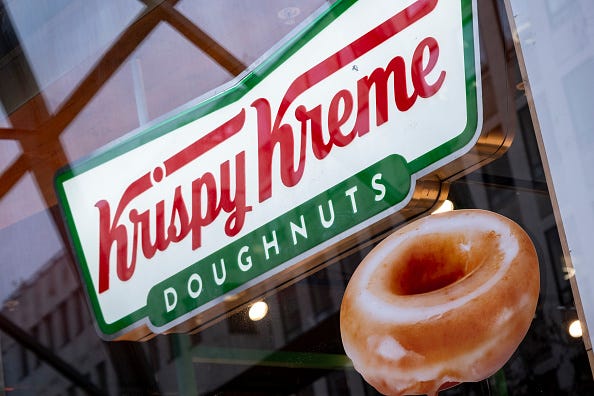
đ„Krispy Kreme: A Hole in Performanceđ„
Also: Simply Interior Homes LLC files for chapter 11, teeing up disputes with Centre Lane Partners
đ©One to Watch: Krispy Kreme, Inc. ($DNUT)đ©
Johnny needed no introduction to Krispy Kreme, Inc. ($DNUT) (the âcompanyâ or âKrispy Kremeâ): his fat a$$ pops in every time he sees that nostalgia-inducing âHOT NOWâ light flick on. But the health-conscious Gen Zers out there, who only eat sh*t like Beyond Meat, might, so letâs take an overly-glazed bite.
The company, which is HQâd in Charlotte, NC, was founded in 1937 by Vernon Rudolph in nearby Winston-Salem. Initially, Mr. Rudolph set out to deep-fry donuts for local grocery stores, but they smelled so good, passersby asked if they could snag one direct. He obliged by cutting a hole in the buildingâs wall for that very purpose. It took off from there, expanding the next few decades within the Southeast through owned-locations and franchisees.
Mr. Rudolph passed away in â73. Three years later, the company brought on the Chicago-based conglomerate Beatrice Foods Companyâs (âBeatriceâ) as the new owner. For its part, Beatrice didnât care whether individual stores profited so long as grocers were buying wholesale; consequently, it did classic conglomerate stuff like mess with recipes and mixes to juice profit margins.
In turn, customers be like âŠ
⊠and the brand suffered. Which prompted Beatrice to sell the company to a group of twenty-two franchisees in â82. Under new ownership, the company shifted its focus to the in-store experience, including by cooking up the idea to let folks watch the entire fresh-donut-production process, a concept later dubbed âhot light theater shops.â Whatever you call it, it was a massive hit, and the company exploded during the â80s and â90s.
In â00, the company IPOâd and kept expanding, which led to over saturation, stores cannibalizing each otherâs business, and another stab at the wholesale biz, the last of which led to market confusion. Was this a premium donut experience or a grocery-store baker? Because, while the recipe was the same, it took longer to get donuts on shelves and, therefore, they werenât particularly fresh. Or good. Accordingly, the company struggled, essentially serving as a revolving door for executives, until, in â16, another conglomerate â JAB Holding B.V. (âJABâ), which owns stakes in, among others, Peetâs Coffee & Tea, Caribou Coffee, and Keurig Dr. Pepper â took it private again.
JAB had the fix for freshness. It moved the company to a âhub and spokeâ model. The hubs consist of those hot light theater shops and âdonut factories,â which make the product behind the scenes and doesnât have a direct retail component. Meanwhile, the spokes are (i) âfresh shops,â which lack their own manufacturing capabilities and (ii) âdelivered fresh dailyâ locations (e.g., grocery stores, convenience stores, quick service restaurants, and the like), each of which receive fresh donuts every single damn day from the hubs.
That, bolstered by the companyâs September â18 acquisition of a 74.7% interest in fresh cookie-delivery biz Insomnia Cookies,* seemed to do the trick. On the revenue side, that is:

However, ~$827.1mm in long-term indebtedness squished the bottom line. In â18, â19, and â20, respectively, the company had net losses of $14.1mm, $37.4mm, and $64.3mm.
Anyway, yâall remember what â21 was like, right? JAB knew a great opportunity to flush its exposure onto some bagholders when it saw one and so it was time to go public yet again. On July 1, 2021, the company IPOâd at $17/share. Hereâs how $DNUT has performed:

Because aside from revenue growth, the business has performed like đ¶ đ©:
Leverage also swung strongly in the wrong direction:
As of December 28, 2025, the debt was comprised of (i) a ~$732.8mm term loan and a $157.5mm revolver, each due March â28 and agented by BNP Paribas, (ii) ~$2.5mm in short-term lines of credit, and (iii) ~$77.9mm in various, long-term lease obligations.
Anyway. Why the poor performance?
Broadly, much of what happened the last time around. Oversaturation, cannibalization, and tension between the concept of being a âpremiumâ donut consumers splurge on vs. a brand you pick up at the grocery store, even if the product is fresher. Unlike last time, GLP-1s are omnipresent, and that too has investors skittish.
More than any of that, though, there was one specific problem. In March â24, and after piloting a program in Kentucky the prior year, the company announced a partnership with McDonaldâs Corp. ($MCD) where thousands of McDonaldâs locations nationwide would effectively become spokes on the hub-and-spoke model, greatly expanding the companyâs reach.
In theory anyway.
It ended up being a disaster.
Given the logistical complexity of delivering fresh to each and every MCD location, the company never converted đ© into đ”. It took a little over a year, until June â25, for the two to call its quits, and the company recorded aggregate, deal-specific impairment charges of $62.1mm.
Which took the company back to the drawing board. In August â25, its turnaround plan surfaced. It is (đ„±) an asset-light, franchise-heavy approach:
That lets the company push costs onto franchisees and lower its capex.
In any event, the company didnât dilly-dally. Here was the 4Qâ25 update:

On March 2, 2026, the company closed the refranchising of its Japanese operations with Unison Capital, Inc., generating $70mm in the process, which went toward debt repayment. A few weeks later, on March 25, 2026, the company closed a deal with its already-established JV partner WKS Restaurant Group (âWKSâ) to sell twenty-three company owned stores to WKS and reduce its equity position in its western-US-focused operations to 20% (from 55%), which itself generated $90mm in value ($53mm payable in cash at closing, the rest through a note). That also went toward debt repayment.***
By the time Q1â26 came to a close, leverage was in a much improved position compared to just a few months prior:

On paper, the business has performed better too:
And the company signed new franchise agreements to enter into the Netherlands.
But overall net loss still came in at ($26.7mm) on the quarter, 5.5x leverage is a significant amount of debt, and the market hasnât fully bought into the asset-light donut strategy. The stock is down ~8.6% YTD:

But up slight since 1Qâ26 results were released.
This one, however, will take some time before (or if) it goes stale. The company has been increasing its cash position alongside debt paydown. As of March 29, 2026, it was sitting on $74.2mm in cash and cash equivalents, up 75% from the prior quarter.
Nevertheless itâs still worth keeping an eye on.
*The company disposed of its stake in Insomnia Cookies over â24 and â25 for an aggregate $247.4mm, which was also used to pay down debt.
**The company completed outsourcing its US logistics entirely in April â26.
***By FYâ27, the company expects to generate ~50% of sales through franchisees, up double from ~25% as of FYâ25.
đ New Chapter 11 Bankruptcy Filing - Simply Interior Homes LLC đ
South Carolina-based Simply Interior Homes LLC, Simply Interior Homes AcquisitionCo LLC (âAcquisitionCoâ) and five other affiliates (collectively, the âdebtorsâ and along with three non-debtor entities, the âcompanyâ) operate a home textiles and home dĂ©cor business that designs, sources and supplies fashion bedding, window treatments, bath products, decorative textiles, and related home furnishings (âsoft goodsâ) for major retailers.*

On June 8, 2026, they filed chapter 11 bankruptcy cases in the District of Delaware (Judge Goldblatt) and here we were thinking to ourselves, âget ready for the usual barrage of lame-a$$ excuses relating to post-covid hangovers, supply chain issues, tariffs, wage problems, yada yada f*cking yada yada (these cases are all getting so damn boring zzzzzzzzz.)â The bankruptcy papers, however, donât(!) reflect those issues (well, other than tariffs). Instead, what weâve got here is a good olâ fashioned post-spinout-clusterf*ck that presages, to the extent thereâs funding to pursue it, litigation against sponsor Centre Lane Partners (âCLPâ)! Yippee!! Letâs dig in âŹïž.
The debtors trace their origin back to the founding fathers of this country, setting up shop in South Carolina way back in ⊠wait ⊠this canât be right ⊠oh, damn ⊠it is right ⊠2025, LOL. Apparently the debtors were carved out of Keeco LLC (âKeeco,â a/k/a Live Comfortably) after Keeco found itself, after years of acquisitions, with too much non-core sh*t to contend with and felt it prudent to offload extraneous product (the âcarve-out transactionâ).**
It seems, though, that Keeco â and by extension, CLP â didnât exactly go about it in ⊠shall we go for it? ⊠yeah, f*ck it ⊠the most comfortable (đ) way imaginable for the debtors.
Thatâs right, according to the debtors,*** they werenât exactly set up for success. They say that they kicked off with an ââŠundercapitalized opening balance sheet from the time of the Carve-Out Transaction as compared to CLPâs projections (which, among other things, the Debtors intend to investigate thoroughly during these Chapter 11 cases)â; and they inherited strained customer and supplier relationships from Keeco, not to mention a reduction in or loss of (in the case of Walmart Inc., $WMT) certain major customer programs that alienated the debtorsâ revenue base. Those issues â meaningful enough on their own, apparently â were compounded further by (i) a dispute over a transition services agreement (âTSAâ) with Live Comfortably and (ii) bollocksed support from CLP, which, in the first instance, failed in its efforts to secure either a recap/M&A deal/refi and, in the second instance and more importantly, allegedly refused ââŠto provide necessary liquidity and capital support for the Debtors in the face of such failed transactionsâŠ.â It seems that, though carved-out per se, the debtors still heavily relied on both Live Comfortably (by way of the TSA) and CLP (as sponsor).**** Tariffs were just the cherry on top.*****
Before we move on. About that TSA.
What. A. Hot. Mess.
Negotiated with prior management and handed off like a hot potato, it basically left anything and everything under Live Comfortablyâs control, e.g., IT, finance, HR, ops support, sales and marketing, merchandising, the list goes on. Significantly, ââŠthe Debtors were delayed in establishing new vendor accounts with certain major customers and as a result were required to rely upon Live Comfortably to receive and remit to the Debtors their customersâ remittance payments throughout the entirety of 2025 and continuing with several major customers in 2026.â
It gets worse. Per the first day declaration of Reflect Advisors LLCâs Adam Zalev, functioning as the debtorsâ CRO (the âdeclarationâ):
âI understand that Live Comfortably, at the direction of CLP, frequently delayed remitting such payments to the Debtors, notwithstanding the Debtorsâ repeated demands for timely remittance. From January to May 2026, the Debtorsâ customers remitted more than 75% of the Debtorsâ collections to Live Comfortablyâs bank accounts. Such amounts ranged from $300,000 to $1.5 million per week during this period. Most recently, during the week ended May 31, 2026, Live Comfortably received approximately $311,000 in payments from the Debtorsâ customers, which were expected to be remitted to the Debtors in a timely manner the following week. As of June 7, 2026, despite repeated requests for payment, Live Comfortably has not remitted the funds to the Debtors.â
And worse âŠ
âThe Debtors intend to investigate and review the reconciliation of all amounts owing by Live Comfortably to the Debtors.â
We bet they do! We also bet thereâs a bunch of excited folks over at UCC-firms across NY and DE: a freefall chapter 11 with potential litigation in play?! Hereâs a live shot of the fine folks over at Pachulski Stang Ziehl & Jones LLP,****** Willkie Farr & Gallagher LLP, Kelley Drye & Warren LLP, Lowenstein Sandler LLP, McDermott Will & Schulte LLP, and others:
Not to state the obvious, but lacking control over your cash is kinda sorta a problemo when youâve got people to pay.
And a bunch of debt on your balance sheet.
Like $17.9mm of prepetition secured debt.
Plus, per the declaration, (i) a $13.8mm second lien subordinated sponsor note issued in favor of CLP and (ii) a $15mm unsecured subordinated sponsor note issued in favor of 11th Lane Holdings SG LLC (together, the âsubordinated sponsor notesâ).
We think.
Weâre actually not at all sure about those đ figures. Why? Because the debtors didnât seem quite so sure about those figures.
This đ is the provision in the declaration related to the subordinated sponsor notes:

Mr. Zalev summarizes, âIn total, as of the Petition Date, the Debtorsâ aggregate obligations under the Subordinated Sponsor Notes are approximately $70 million.â
Look, Johnny is dumb as bricks and smashed way too many beer cans against his forehead in college but even he knows that the âŠ
Perhaps the DIP motion will shed some light on this disparity? Hereâs what that document had to say about the prepetition capital structure:

Ok, it seems thereâs a second earlier note from CLP that Mr. Ayers hadnât accounted for in his entered-into-evidence-declaration (lol). But even accounting for the DIP motionâs second earlier CLP note of $8.8mm, well âŠ
Were there other secured subordinated sponsor notes?
It seems the proposed DIP order sheds some light on the disparity. Hereâs a provision describing the CLP-related secured subordinated sponsor notes:

For the holy love of G-d. Say what now? Whereâd this $43.8mm sponsor note come from? Why wasnât it mentioned in the declaration? Or the DIP motion? And whatâs with the CLP IV note? Thereâs three different documents with three different amounts attributed to that particular note: the declaration says the CLP IV note is $13.8mm, the DIP motion says the CLP IV note is $8.8mm, and the proposed interim DIP order says its $5.2mm.
Even adding the new found CLP V note to the highest-valued CLP IV note, where does the $70mm total come from? Why canât any of these people do math?!?*******
Or write a fulsome paragraph that actually tells us how the capital structure breaks down?
Anyway, below the secured debt and however the f*ck number of subordinated sponsor notes there may or may not be, thereâs also $12mm in trade debt owed to ânon-go-forwardâ â aka âf*ckedâ â vendors, exclusive of additional amounts that may fuel the GUC pool higher that are related to ââŠ(a) amounts owed to go-forward trade vendors, the full scope of which the Debtors continue to assess; (b) disputed amounts asserted by Live Comfortably under the TSA (as more fully described below); (c) lease obligations relating to the Debtorsâ office, showroom, and other facility locations; and (d) employee-related obligations.â
Ok, now that thatâs past us â and we send our advance apologies to all the professionals involved (but câmon, donât @ us) â letâs just be honest about whatâs going on here. The prepetition secured creditors â GRC SPV Investments LLC (âGRCâ) and Wingspire Capital LLC â are over all of the nonsense. Starting in June â25 and through April â26, Great Rock Capital Partners Management LLC (âGreat Rock,â affiliate of GRC), acting as administrative agent under the prepetition credit facility, delivered various notices of default to the debtors and/or CLP citing, among other issues, an over-advanced borrowing base. After CLP allegedly gave zero f*cks and lent very little additional support to the company, Great Rock then exercised proxy rights and appointed Stuart Kaufman of Arete Capital Partners LLC as independent manager of AcquisitionCo, the top debtor in the companyâs org structure, and vested him with sole and exclusive decision-making authority. While the prepetition secured lenders did provide some additional funding under the credit facility to fund critical needs like payroll, lease payments and payments to the debtorsâ third-party logistics providers, there remained a glaring liquidity need and Mr. Kaufman rolled up his sleeves and got to work.
And so, of course, the debtors explored their options but all roads led to chapter 11 and a DIP credit facility. The prepetition secured lenders stepped up there too: theyâre offering a headline $15mm DIP comprised of a $5mm new money RCF â all on an interim order because thereâs $3.3mm thatâs needed to push forward the debtorsâ proposed sale â and a creeping 3:1 roll-up of pre-petition indebtedness up to $10mm (which, per the budget, appears poised to hit the $10mm within the first four weeks of the case). The DIP carries a repayment mechanism to be remitted out of daily collections, the proceeds of a liquidation process performed by SB360 Capital Partners LLC (âSB360â) and any other proceeds received, first to the new money DIP portion, then the roll-up and then to the remaining prepetition secured obligations. The DIP interest rate is SOFR+7.5%, thereâs an unused line fee equal to 0.75%, a $5k/month collateral monitoring fee, and a 2% PIK closing fee.
Which gets us to the sale process. The debtors already have a bid procedures motion on file (subject to shortened notice because the debtors didnât market prepetition and say they need all of the time they can get prior to the đ sale milestones). Thereâs no stalking horse in tow but the debtors hope to have one designated by July 1, 2026 with a July 30, 2026 auction date and an August 6, 2026 sale hearing. Contemporaneously, SB360 will be liquidating inventory, outstanding A/R, FF&E and more. The debtors say they can turn that off if thereâs a buyer but we wonât hold our breath.
The debtorsâ first day hearing was on June 9, 2026 at 1pm ET and thank G-d almighty the debtors acknowledged right off the bat that theyâll need to file a supplement to the declaration to solve for the pervasive inconsistencies relating to the subordinated sponsor notes. Thanks yâall, đ. Not to beat a dead horse, but that sh*t was a horrible. Beyond that, the hearing was rather uneventful â a few tweaks to the SB360 agreement, shortened notice for the sale approved (subject to an official committee of unsecured creditors demanding more time), no real issue with the roll-up, etc. Notwithstanding our harping on the subordinated sponsor notes mess, this was a very comfortable first day hearing.
The debtors are represented by Goodwin Procter LLP (Kizzy Jarashow, Barry Bazian, Yelizaveta âLizaâ Burton, Artem Skorostensky) and Potter Anderson & Corroon LLP (L. Katherine Good, Brett Haywood, James Risener III) as legal counsel, the aforementioned Reflect Advisors LLC (Adam Zalev) as financial advisor and CRO, and Rock Creek Advisors LLC (Brian Ayers) as investment banker. Stuart Kaufman is the debtorsâ independent manager and he is represented by the omnipresent Pachulski Stang Ziehl & Jones LLP (Mary Caloway, Gregory Demo, Benjamin Wallen). SB360 is represented by Katten Muchin Rosenman LLP (Grace Thompson). For its part, Great Rock is represented by Paul Hastings LLP (Roger Schwartz, Peter Montoni, William Reily, Alison Sikes) and Young Conaway Stargatt & Taylor LLP (Joseph Barry, Joseph Mulvihill). And, lastly, CLP is represented by Greenberg Traurig LLP (Nathan Haynes, Livy Mezei, Anthony Clark).
*The debtors private label soft goods for brands like Eclipse (sold in places like Walmart Inc. ($WMT)), Hookless, Historic Charleston and Kate Spade Home.
**The Live Comfortably name came immediately after the carve-out transaction. We wonât go into the details of the carve-out transaction but it seems pretty clear that the debtors and an eventual official committee of unsecured creditors will have a good time looking into that transaction and any potential causes of action that may stem therefrom.
***Reading the declaration, we were sure that Centre Lane was going to have a different take. Indeed, at the beginning of the first day hearing, Greenberg Traurig LLPâs Nathan Haynes said, ââŠwith respect to the characterization of the facts and circumstances leading up to the filing of these cases as set forth in the first-day declaration, we believe that Centre Lane has been painted in a very unfair light. We strongly disagree with a number of the debtorsâ allegations, and we look forward to the opportunity to correct the record at the appropriate time.â
****Thereâs not a massive real estate footprint here, apparently, but the debtors do maintain a showroom in NYC that they share with Live Comfortably. Otherwise, the debtorsâ principal office is in South Carolina and, aside from some overseas sourcing offices in China, Pakistan and India, there are only third-party warehousing facilities in Nevada and Indiana.
*****The debtorsâ goods are sourced, manufactured by and supplied from primarily India, Pakistan, China and Vietnam. The debtors rely on third-party logistics providers and freight carriers for transport. You can, therefore, get a sense for why tariffs may have been impactful. Notably, the top 30 list of unsecured creditors is replete with foreign vendors.
******Just kidding. Taking a bird in hand, Pachulski Stang Ziehl & Jones LLP signed up to represent the independent manager. We get it: that sounds like a great option over a freefall retail bankruptcy with a hairy as all f*ck history with its previous owner and current private equity sponsor, đ.
*******Goodwin & Procter LLPâs Kizzy Jarashow literally said, in the context of explaining DIP mechanics to Judge Goldblatt at the first day hearing, âYou donât want me to do the math.â LOL, weâre not sure we want anyone involved with this case to do the math.
đResourcesđ
We have compiled a list of a$$-kicking resources on the topics of restructuring, tech, finance, investing, and disruption. đ„You can find it heređ„.
đ© Notice đ©
Thomas Salerno (Partner) joined Kutak Rock from Stinson LLP.
đŸCongratulations toâŠđŸ
Dundon Advisers LLC (Joshua Nahas) for securing the financial advisory mandate on behalf of the official committee of unsecured creditors in the Freedom Forever LLC chapter 11 bankruptcy case.
Dundon Advisers LLC (Matthew Dundon) for securing the financial advisory mandate on behalf of the official committee of unsecured creditors in the QVC Group, Inc. chapter 11 bankruptcy cases.
Kelley Drye & Warren LLP (Eric Wilson, Jason Adams, Maeghan McLoughlin, Andres Barajas, Connie Choe) and Ice Miller LLP (Christopher Samis, Aaron Stulman, Sarah Gladieux) for securing the legal mandate on behalf of the official committee of unsecured creditors in the West Marine Inc. chapter 11 bankruptcy cases.
Moshe Jacob on his promotion to Counsel at Skadden Arps Slate Meagher & Flom LLP.
Proskauer Rose LLP (Brian Rosen, Ehud Barak, Daniel Desatnik, Paul Possinger, Jordan Sazant) and Cole Schotz P.C. (Luis Salazar, Justin Alberto, Sarah Carnes) for securing the legal mandate on behalf of the official committee of unsecured creditors in the CHS FL, LLC chapter 11 bankruptcy cases.
Willkie Farr & Gallagher LLP (Brett Miller, Paul Labov, James Burbage, Jennifer Hardy) for securing the legal mandate on behalf of the official committee of unsecured creditors in the Bitcoin Depot Inc. chapter 11 bankruptcy cases.