
🔥Johnny's Doomsdaying for Clicks (#10)🔥
Artificial Intelligence, SPACs, Red Lobster, The Prince Group & More
Of course there’s THE link from Tuesday (April 14, 2026) that had people — inside and outside of RX circles — talking about the state of biglaw:
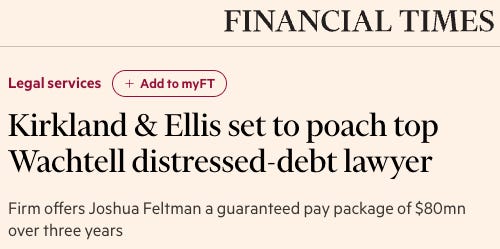
This is bananas:
“Kirkland & Ellis is set to poach the head of arch-rival Wachtell Lipton’s restructuring practice in an effort to rebuild its own distressed debt group after the departure of a star partner earlier this year.
Kirkland has offered Joshua Feltman, the chair of Wachtell’s corporate restructuring and finance department, a guaranteed pay package of $80mn over three years to tempt him away from Wachtell, according to people familiar with the matter.”
There’s a lot of people reading that and questioning life choices — and by people we mean everyone from bankers and hedgefunders who left biglaw …
… to f*cking baseball players like Freddie Freeman, star first baseman of the Los Angeles Dodgers and World Series hero …
… who, despite 370 career homeruns and a lifetime .299 batting average, never in his f*cking life made an annual amount as high as, lol, this guy:
Oh damn. That happened fast.
Johnny, cue the backup … this guy:
Honestly, good for Mr. Feltman. Get that cheddar while you can is how we feel (and, hey Josh, feel free to throw some spare change to your friends over at PETITION who helped build your profile, 😉).
Let’s take a moment to call back to our “observations” from nine days ago:
Looks like we need to add a “#8” to the mix.
Which begs the question: who will be #9 in this game of RX dominoes?
And now to the rest of the links 👇.
🔗What We’re Reading (8 Reads)🔗
1. Artificial Intelligence (Long Fear). In Johnny’s last edition, he included a long bit about artificial intelligence and, specifically, how the news about Anthropic’s Mythos seemed to be scaring the sh*t out of everyone … including, it seemed, Anthropic itself. Hence why they assembled the mission critical Avengers, e.g., Apple Inc. ($AAPL), JPMorgan Chase & Co. ($JPM) and dozens of others and provided them and only them with access so that they could use it to plug cybersecurity weaknesses that Mythos uncovered (call sign: Project Glasswing). Subsequently we learned that Secretary of Treasury Scott Bessent called an emergency meeting with, among others, banking execs, to diligence to what degree the federal government ought to be sh*tting bricks. We also witnessed the usual chorus of cynics who claim that Anthropic is saying this stuff about its own product just for clicks.
We have no idea what the truth is. We did, however, read this …
… and … 😬. If you want to skip all of the tech mumbo jumbo, fine do so, you can scroll to the subsection entitled “Oh, Also, If Anyone Builds It, Everyone Dies,” which discusses super-intelligence and existential risk. All of it is very fearmonger-y and we don’t know how much credence to give it but, just in case, we’re now going to go cuddle in bed with the kids and start thinking up ways to store months worth of bottled water in a small NYC apartment. For your part, you can keep reading Links 👇 … more prep time/materials for us.
2. Artificial Intelligence Part II (Short Compute?). Is it possible that the one thing that might delay existential risk is the lack of infrastructure and therefore the cost to “compute”?!? Here is Theory Ventures’ Tomasz Tunguz highlighting how this dynamic may very well separate the proverbial men from the boys, creating an “AI to the Highest Bidder” dynamic.
Btw, it’s worth mentioning that the same funds that we’re seeing in RX circles are out there financing the infrastructure build.
3. BDCs (Long Extensive Outflows). Here, Fitch Ratings takes measure of the redemption waive from January through March. TL;DR: it’s baaaaaaad.
4. Private Credit (Long Goldman’s Harbinger). Goldman Sachs Group Inc. ($GS) reported earnings on Monday and the stock fell nearly 2% on the day’s trading after the firm reported … checks notes … its second-highest quarterly revenue ever, beat revenue and EPS expectations, and surprised to the upside on equities and investment banking revenue. Wait, what? That sounds f*cking amazing, so why did the stock trade down (on $17.23b of revenue and a $1.01 EPS beat)? Fixed income, that’s why: it fell 10% to $4.01b, missing by $910mm, 😬. Attached to that is the fact that GS took a $315mm provision for credit losses, reflecting primarily impairments related to wholesale loans and, as far as some market participants saw it, possible reverberations from the “golden age of private credit” coming to an end. But, well, maybe not. Per CEO David Solomon:
“In alternatives, we raised $26 billion across asset classes with private credit strategies generating $10 billion. We recognize that the private credit industry has been an area of increased focus in recent months. Our 30-year track record of performance in private credit is characterized by rigorous underwriting, selective deployment and disciplined portfolio construction. And our largest non-traded BDC, as an example, we saw net inflows of over 7% this quarter, reflecting divested investor demand for experienced investment managers who have navigated multiple rate and credit cycles. Looking forward, our predominantly institutional drawdown structures as well as the breadth of our origination funnel give us the flexibility to continue to patiently and selectively invest capital.
Overall, we feel good about the long-term opportunity in private credit and our ability to deliver attractive risk-adjusted returns for clients.”
Hmmm, seems like a disconnect there but the answer lies (if these aren’t lies, and by G-d that’d be crazy if they were) in the investor base. GS’s private credit platform works with institutions rather than retail. Per Solomon again:
“…when you look at our first quarter 2026 subscriptions in our GS credit BDC, 40% of them were from institutions, many of whom are first-time investors on our platforms, including insurance companies, banks, pension funds. And when you look at our broad platform, it’s over 80% institutional partners very, very broad, very, very diverse. And we’ve been growing it over a long period of time. You obviously saw our positive inflows of what we raised privately in the quarter, we feel we’re very well positioned and actually the opportunity set to some degree, is improving. I know people are very focused on the cycle, and they should be.
This has been a long period of time ex the COVID shutdown been a long period of time without, what I call, a normal credit cycle, meaning a meaningful slowdown in the economy, or a recession. Whenever you have a meaningful slowdown in the economy or a recession, there are higher loss levels in diversified credit portfolios. I think risk management and portfolio construction are very important in places where people haven’t followed their portfolio construction carefully and they’ve gotten overweighted to a particular sector. They’ll obviously have more headwinds. But I don’t -- I think one of the things that’s really not getting a lot of attention is if you do have a cycle, what does that look like?
And so if you take a very tough cycle in the global financial crisis, the cumulative default rates across the entire leverage lending space, the entire leverage lending space during the global financial crisis was 10%, recoveries were about 50%, so the cumulative loss was 5% to 6% against coupons of 9% to 10%. And so that is the business model of this. I think institutional investors understand that. I think there’s going to continue to be some noise around the retail space. I think you should watch that carefully.”
So the “dumb money” is leaving private credit but the “smart money” is staying put? It will be interesting to see how this all plays out.
5. Opera (Long Chalameeeeeet). Per Walter Hickey citing Bloomberg, “[t]he Metropolitan Opera in New York is in difficult financial straits, with their box office revenue for the past fiscal year coming in at only $70 million while its budget stood at $326 million. It’s getting to the point where there are serious concerns about the long-term fiscal health of the organization, sure, but it’s not like they’re selling the fixtures just to keep the lights on. Actually, they’re literally going to do that: the two iconic, massive 36-foot by 30-feet paintings by Marc Chagall titled The Sources of Music and The Triumph of Music that soar over the opera’s lobby have gone up for sale.” Um, there’s a word for businesses that spend more money than they make, wish we could remember what it is, 🤔. In any event, it seems Johnny’s boy Timothée Chalamet took some unwarranted heat for his comment to Matthew McConaughey that “no one cares about [opera] anymore.”
Those numbers 👆 don’t lie. Right Timmy?
6. Prince Holding Group (Short Transnational Criminal Organizations). You don’t see this everyday. On April 8, 2026, Cambodia-based The Prince Group filed chapter 15 bankruptcy cases in the Southern District of New York to obtain recognition of insolvency proceedings involving 30 British Virgin Islands-incorporated entities. The filing comes in the wake of a US Department of Justice (“DOJ”) crackdown on the company and its founder/chairman, Chen Zhi, who allegedly (i) ran forced labor compounds wherein people were coerced into participating in sophisticated crypto scams, (ii) engaged in human trafficking, and (iii) naturally, threw in some good ol’ fashioned money laundering to boot. In other words, lots of illegal sh*t … basically crypto’s number one use case. The DOJ — in what amounts to the largest civil forfeiture action in US history — moved to seize ~127,271 BTC, which is alleged to be the proceeds of the group’s shady a$$ sh*t, and at the time of seizure was worth around $15b. Today it’s worth only $9.4b but Sullivan & Cromwell LLP (“S&C”) is involved now which means BTC is destined to 🚀 if FTX is any historical indicator (not investment advice). Indeed, since S&C’s chapter 15 filing, BTC is already up 4.4% as of the time of this writing (on Tuesday, April 14 at 12:07am).
7. Red Lobster (Long Predictability). Mwahahahahahaha, it turns out it wasn’t just the endless shrimp that was the problem. It was the eat-it-and-get-the-runs shrimp that was the problem. Here is Bloomberg reporting that TCW Group (via TCW Direct Lending VII LLC) marked down its equity stake in RL Parent Holdings LLC (f/k/a Red Lobster Management LLC) to basically a 🍩 (okay, not exactly, but down from $31mm to just under $1mm).

TCW did not, however, mark down the $56.3mm worth of (growing, PIK!) term loan exposure to Red Lobster (really RL Investor Holdings LLC), which they seem to think still has a shot in hell of reaching its ‘29 maturity/refi, L.O.L.

As you might expect, there were some … reactions … many as bad as Red Lobster’s food:
8. SPACs (Long Public Access to Sh*tcos). The IPO market has been tame and, at least since the war against Iran, the M&A environment has been muted but one market continues nevertheless: the SPAC market. Per Pitchbook, “In Q1 2026, 62 SPACs went public in the US, raising a cumulative $13.2 billion in proceeds, according to SPAC Research data. In that same period, 41 SPACs filed to go public, 17 announced merger transactions, and 10 closed deals—all in line with 2025’s pace.” We know what you’re thinking: I.N.V.E.N.T.O.R.Y. Yeah, maybe. But remember that the regulatory environment for SPACs is substantially different than what was at peak-grift (‘21). Indeed, it can best be described as “IPO-ification,” with a regulatory shift that more closely mirrors traditional public offerings.
To understand this better, you need to take a quick time machine ride to ‘24, when the US Securities & Exchange Commission issued new rules around SPACs — it seems sh*tco after sh*tco filing for bankruptcy got some regulators thinking that moms and pops ought to have some more protections out there … or something. And so the SEC basically stripped SPACs of "safe harbor" protections for aggressive financial projections and mandating that target companies serve as co-registrants, thereby imposing strict Section 11 liability on their management teams for any misstatements; it also complemented these changes with more robust disclosure requirements. All of which means that there should be more transparency, audit quality, and legal accountability. Good for mom and pop. Bad for Cooley LLP’s debtor flow, 🤷♀️.
😂F*cking Ridiculous Sh*t of the Week😂
Well, maybe not as ridiculous as $80mm/3-years for a gawddamn lawyer, but still ridiculous:
🎧What We’re Listening To🎧
📚Resources📚
We have compiled a list of a$$-kicking resources on the topics of restructuring, tech, finance, investing, and disruption. 💥You can find it here💥.


