

💥New Chapter 11 Bankruptcy Filing - Hughes Satellite Systems Corporation💥
DISH sister falls out of orbit, crashes into chapter 11

On August 2, 2026, EchoStar Corporation ($ECHO)-owned Hughes Satellite Systems Corporation and eleven affiliates (collectively, the “debtors” and together with their non-debtor subsidiaries, the “company”) filed chapter 11 bankruptcy cases in the Southern District of Texas (Judge Perez).
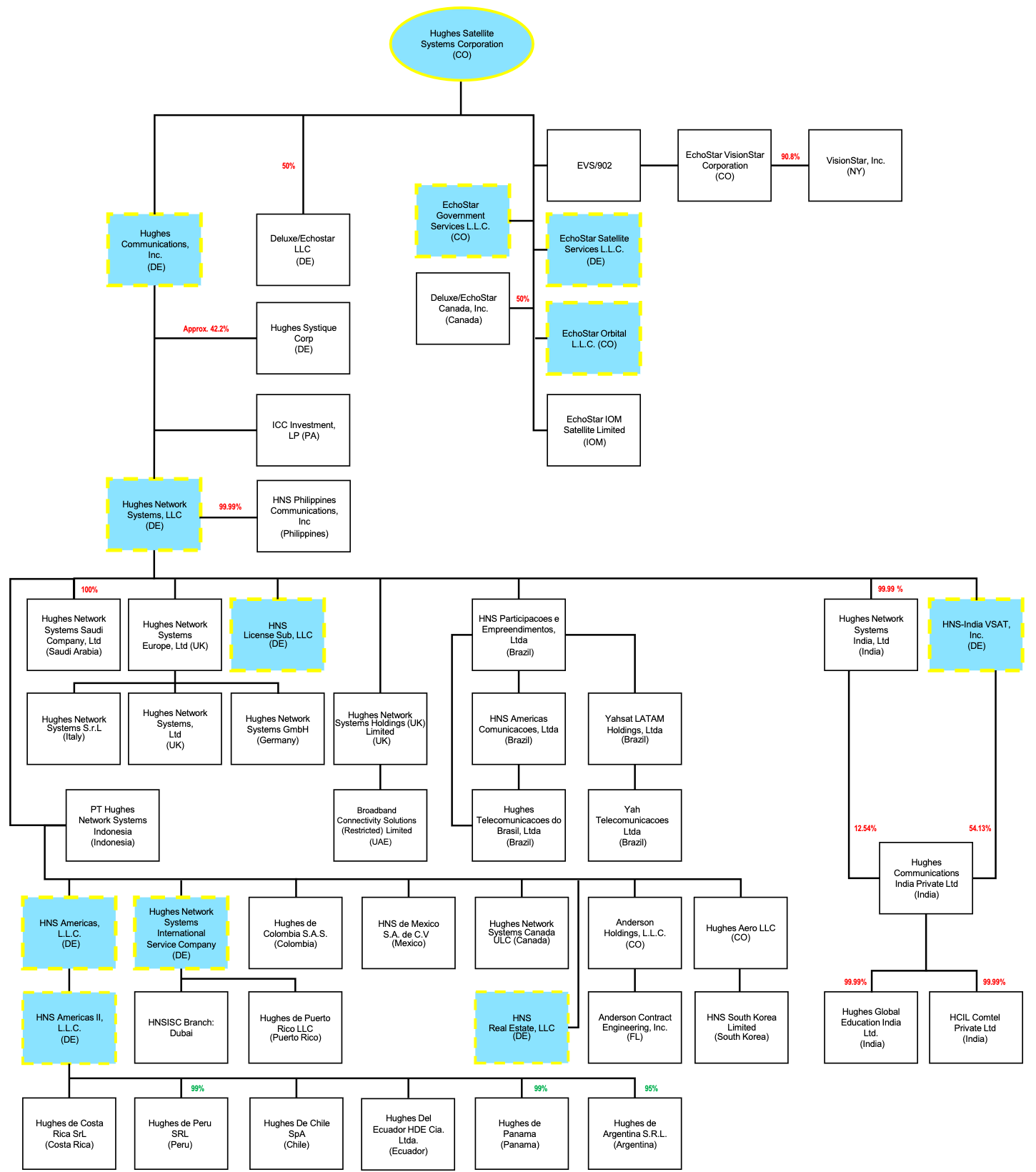
In case the thought crossed your mind, yes, the ECHO-parented debtors are sister cos. of the “prepackaged” DISH DBS Corporation cases.

In this instance, though, counsel White & Case LLP (“W&C”) dispensed with deigning to tricks us all with any sort of “prepack” label.
Anyway, let’s turn back to the company. It (i) provides broadband internet service to rural communities, (ii) sells enterprise and government services to multinationals and, well, governments, and (iii) designs and manufactures satellite systems and related tech for operators and, again, governments.
On the consumer broadband side, the company has ~641k subscribers as of the petition date, which is … uh … part of a death spiral. A year prior, the company had ~819k, a ~21.7% YOY decline, and there is no coming back. This part of the business is basically a dinosaur because its satellite internet service uses geostationary orbit (“GEOs”) networks hovering about 22.3k miles above the equator. That height comes at a significant cost: latency is huge, about 600ms for round-trip of the signal.
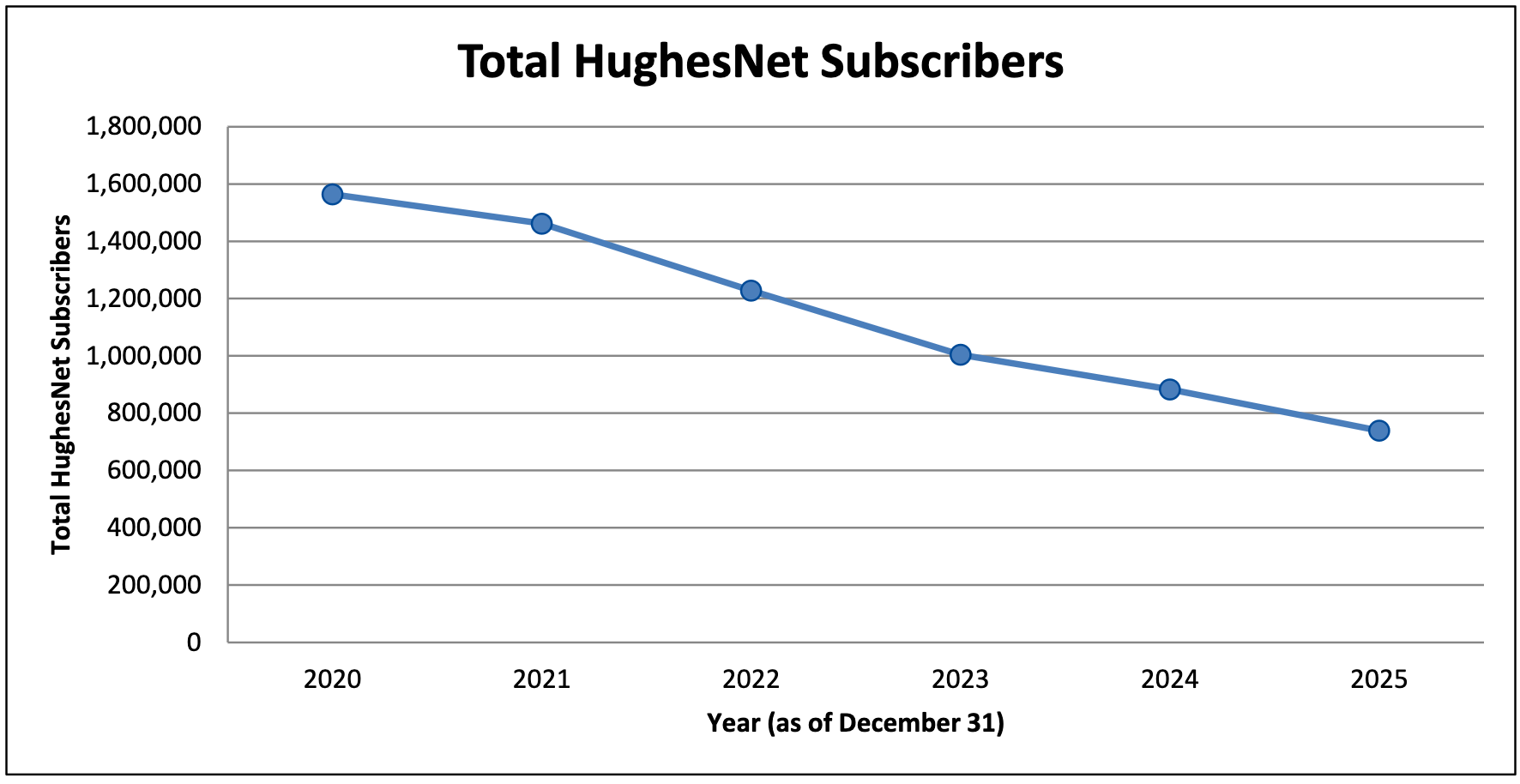
GEO, however, is no longer the only option. Space Exploration Technologies Corp. ($SPCX) (“SpaceX”), Amazon Leo, and “… other operators …” have moved into the market and provide internet access using newer-age, low-earth orbit satellites, which sit at ~210 to ~750 miles above the earth and are, at their absolute apex height, ~3.3% of the GEOs’ total distance. Speeds are therefore substantially faster, and latency isn’t even an issue; it’s about 20 to 40ms, effectively the same as traditional broadband providers. Ergo, consumers have flocked over to the company’s competition, resulting in GEO posting a ~$1.3b loss for FY’25.
⚡️Let’s take a brief tangent here. SPCX reported its Q2’26 earnings earlier this week — its first earnings as a public company — and Starlink is clearly the company’s primary revenue engine. It drove $4.29b of revenue in the quarter, up a staggering 66% YOY. If you’re wondering how that fits into the overall enterprise, Starlink represents 54% of SPCX’s total $7.81b of revenue, far outweighing earnings from 🚀, AI, etc, and is the only profitable business segment. How? Well, the Starlink subscriber base is now 12mm, double what it was last year. Commercial adoption is also soaring, with revenue up 108% YOY to $1.81b. In fact, you may have indirectly noticed this adoption the last time you flew, say, Virgin Atlantic or American Airlines ($AAL). While all of that 👆is obviously impressive, it’s still rough for the likes of GEO to lose to a company that overall is incinerating cash, including, at least thus far in its early tenure, public equity investor cash (though, to be fair, that 👇 stock price is only minimally off the IPO price … it was much farther off just a few days ago … SPCX ripped this week, despite the dreaded lock-up expiration that everyone predicted would sink it farther).⚡️
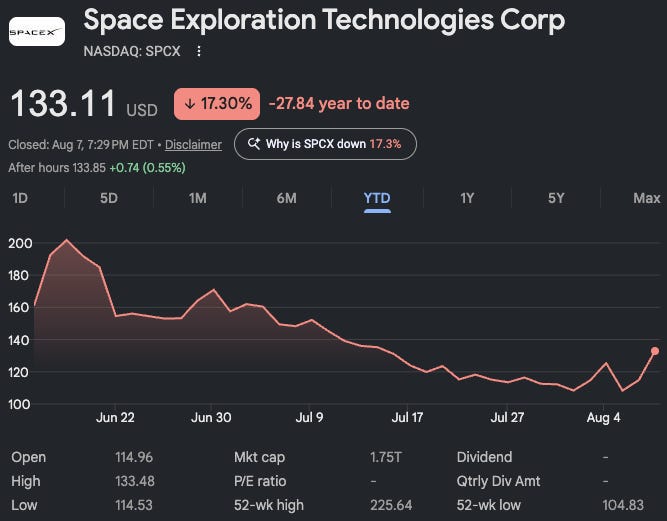
Ok, now we’re back — and SPCX will be too 👇.
All of the foregoing has the company thinking its future is in the second business segment ☝️, and that’s where 100% of its focus has been placed. A business for which you apparently need a substantially smaller headcount. In late July ‘28, the debtors notified ~400 employees they’d be clocking out for the last time within the next two months.
No doubt that’s upsetting to many of the formerly employed. But you know who also ain’t tickled? The holders of the debtors’ (i) ~$750mm in principal amount senior secured notes (the “secured notes”) and (ii) ~$750mm in principal amount senior unsecured notes (the “unsecured notes”), each of which matured on August 1, 2026 and haven’t been paid back.* The debtors also declined to engage with the noteholders prior to kicking off the chapter 11 cases. They never even bothered to send drafts of customary first day papers.
You know who takes offense to that? Jones Day’s Bruce Bennett, which had Johnny all like:
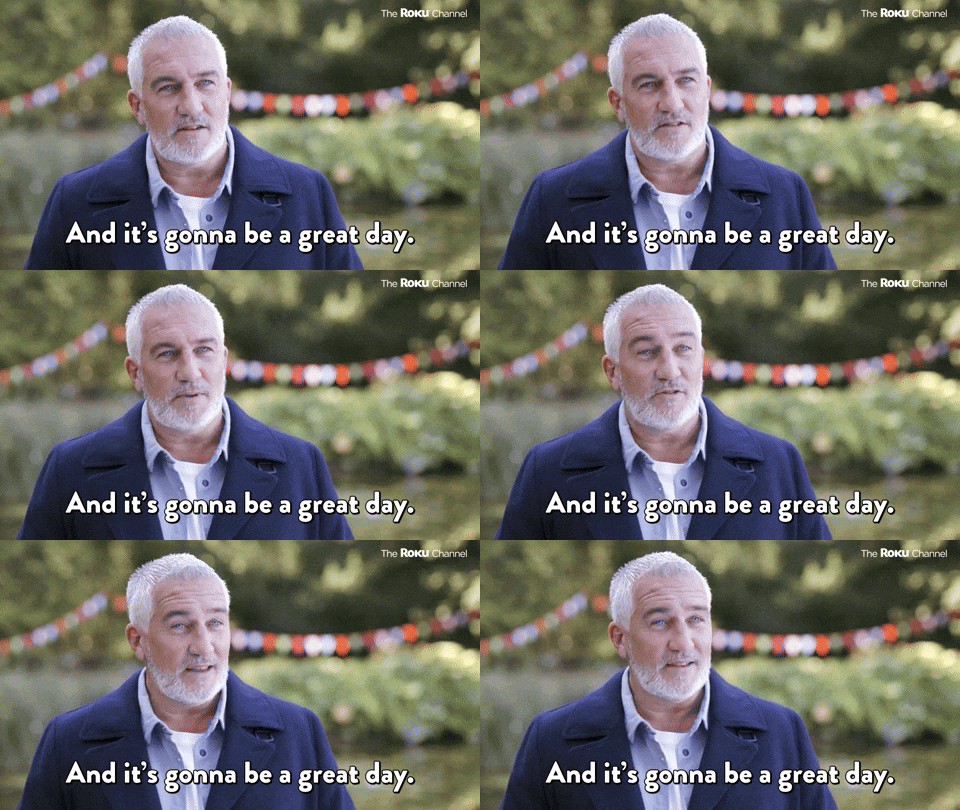
Legend.
Mr. Bennett and his team represent an ad hoc group of 69%+ of the secured notes and 82%+ of the unsecured notes (the “ad hoc group”), and prior to the petition date, the group was busy. On July 21, 2026, it sent a love letter (😜) to W&C — attached to the cash collateral motion (the “cc motion”) — expressly noting their lack of consent to cash collateral usage and outlining “… claims that the Noteholders have identified thus far, which could generate well in excess of $1.7 billion …” What kind of claims? The letter only scratches the surface, but we’ll skip forward in time — on August 5, 2026, Mr. Bennett dove into more detail … in a motion to appoint an examiner:
“The Jupiter 3 Satellite Lease. In 2023, EchoStar caused Hughes to enter into an above-market lease for EchoStar’s Jupiter 3 satellite (the ‘Satellite Lease’), owned by EchoStar’s subsidiary, EchoStar XXIV, LLC (‘EchoStar XXIV’). This satellite lease became effective in December 2023, triggering approximately $191 million annually in lease payments. At this rate, Hughes will have paid EchoStar XXIV enough in lease payments to fully cover EchoStar XXIV’s cost of constructing the satellite in just over 2.1 years and also paying for the ancillary gross costs of the satellite, such as launch costs, in just three years, despite the satellite having well over a decade of remaining economic useful life …
Cash Dividends. On February 15, 2024, Hughes declared and paid a $529 million cash dividend to EchoStar (the “February Dividend”). The next month, on March 12, 2024, Hughes declared and paid another $500 million cash dividend to EchoStar …
Excessive Tax Payments. In 2024, Hughes paid EchoStar approximately $196 million allegedly related to income taxes. This tax payment to EchoStar was wildly out of line with cash tax payments Hughes reported in the prior three years, where Hughes paid just $4.9 million in 2023, $12.5 million in 2022, and $10.6 million in 2021 … neither Hughes nor EchoStar has disclosed the existence of any tax sharing agreement between them since then that would explain or justify this payment.
Prepayment of Satellite Lease. In March 2024, Hughes prepaid $100 million in EchoStar XXIV satellite lease obligations, and in June 2024 prepaid an additional $85 million, further depleting Hughes’s liquidity for the benefit of an EchoStar subsidiary without any corresponding benefit to Hughes …
The SpaceX Transaction. In September 2025, EchoStar announced an agreement to transfer various spectrum licenses and related assets to SpaceX, including the referral of Hughes’s subscribers to SpaceX in exchange for a referral fee … In addition, it appears from Hughes’s annual report for 2025 that Hughes may also have agreed to transfer certain satellite assets and regulatory authorizations to SpaceX as part of the EchoStar transactions with SpaceX. Publicly filed financial reports do not show the percentage, if any, of the transaction consideration, including SpaceX shares, that have been allocated to Hughes in exchange for its participation in the transaction.”

Who cares about the merits. This is leverage first and foremost, and Mr. Bennett is the 🐐 for making his enemies’ existences a living hell. Not that the motion was limited to those types of claims. Naturally, related fiduciary sh*t followed, especially purported claims against controller shareholder Charles Ergen. We especially liked this bit relating to purported “independent directors” appointed by Mr. Ergen to post facto deal with some of the hair on this dog:
“As professional “independent” directors, each of them fully understands that he will not have any future employment opportunities as “independent” directors if they take any action that is contrary to the wishes of the parties responsible for appointing them. Regardless of the integrity and experience of the individuals expected to serve as “independent” directors, they cannot be considered as truly independent when they are engaged and compensated at the direction of the very persons and entities that are being investigated. There is no reason why the estates should have to bear the risk of relying on an investigation that has even a small chance of infection by bias, corruption or incompetence.”
How dare Mr. Bennett impugn the integrity of the (professional) independent director industry! Suffice it to say, he thinks an examiner who ain’t beholden to Mr. Ergen or the professionals involved here will be a fairer arbiter.
It’s hard to blame Mr. Bennett for taking aggressive action because, jumping back in time, his prior letter fell on deaf ears. Which is not to say he didn’t ramp up shortly thereafter. On July 28, 2026, the ad hoc group also delivered a letter to the court opposing emergency first day relief — W&C attached that one to the cc motion too. Naturally, the group objected to the debtors’ first day relief, couched as an adequate protection beef, as well.
Regardless, the court-letter didn’t stop the first day hearing from pushing forward on August 3, 2026, where Mr. Bennett grilled the debtors’ CRO and FTI Consulting, Inc. ($FCN)’s Robert Del Genio since he’d been in the role for … five minutes? Okay, it’d been five days, a timeframe that similarly extended to the debtors’ independent directors Anthony Horton and FTI-alum Michael Buenzow, who are, you know, very independently performing an investigation with the aid of Kirkland & Ellis LLP.
In any event, it wasn’t much time and Mr. Bennett’s efforts weren’t a waste. For one, he created delay — an achievement in itself; the hearing didn’t end on August 3 and extended ~1.75 hours into the next day. For two, he almost got the debtors to settle … but the parties never got across the finish line. For three, that wasn’t too big a deal — ahead of that second day, the debtors revised the interim cash collateral order to incorporate most of the changes Mr. Bennett had asked for, including removal of the professional fee carveout.
Most importantly, though, the court didn’t just defer to the debtors thereafter: Judge Perez took it a step further on August 4 and kicked the can down the road by requiring the debtors to escrow interest on the notes until the second day hearing (interim order here). The court will catch up to the kicked can at the second day hearing, which is scheduled for August 26, 2026 at 1pm CT — the date on which the court will also take up the examiner motion, 🍿.
The debtors are represented by W&C (Thomas Lauria, David Turetsky, Michael Shepherd, Jason Zakia, Matthew Linder, Roberto Kampfner, Charles Koster, Adam Swingle, Matthew Brown, Fan He) as legal counsel and FCN (Robert Del Genio) as financial advisor and CRO. The debtors’ special committee is composed of Anthony Horton and Michael Buenzow and is represented by Kirkland & Ellis LLP (Patrick Nash, Jr., Matthew Fagen, Ciara Foster, Richard Howell, Ravi Subramanian Sankar, Michael Esser) as legal counsel. The ad hoc group of noteholders is represented by Jones Day (Bruce Bennett, Joshua Mester, Benjamin Sandberg, Oliver Zeltner) as legal counsel. U.S. Bank Trust Company, National Association, as unsecured notes indenture trustee, is represented by Seward & Kissel LLP (John Ashmead, Catherine LoTempio, Shivani Patel) as legal counsel. Customer Delta Air Lines, Inc. ($DAL) is represented by Hughes Hubbard & Reed LLP (Kathryn Coleman, Jeffrey Margolin) as legal counsel.
*The debtors also assert to owe ~$51mm to ECHO, of which $50mm is secured, under intercompany financing arrangements.
Company Professionals:
Legal: White & Case LLP (Thomas Lauria, David Turetsky, Michael Shepherd, Jason Zakia, Matthew Linder, Roberto Kampfner, Charles Koster, Adam Swingle, Matthew Brown, Fan He)
Financial Advisor/CRO: FTI Consulting, Inc. ($FCN) (Robert Del Genio)
Special Committee: Anthony Horton and Michael Buenzow
Legal: Kirkland & Ellis LLP (Patrick Nash, Jr., Matthew Fagen, Ciara Foster, Richard Howell, Ravi Subramanian Sankar, Michael Esser)
Claims Agent: Epiq (Click here for free docket access)
Other Parties in Interest:
Ad Hoc Group of Holders of Senior Notes
Legal: Jones Day (Bruce Bennett, Joshua Mester, Benjamin Sandberg, Oliver Zeltner)
Secured Notes Indenture Trustee: Wilmington Savings Fund Society, FSB
Legal: Pryor Cashman LLP (Seth Lieberman, Patrick Sibley, Andrew Richmond, Daniel Brenner) and Vinson & Elkins LLP (Paul Heath, Kiran Vakamudi, Ariana Erfani, Steven Abramowitz)
Unsecured Notes Indenture Trustee: U.S. Bank Trust Company, National Association
Legal: Seward & Kissel LLP (John Ashmead, Catherine LoTempio, Shivani Patel)
Customer: Delta Air Lines, Inc.
Legal: Hughes Hubbard & Reed LLP (Kathryn Coleman, Jeffrey Margolin)