
💥Hits from the B...💥
The Cannabist Company Holdings Inc., Zynex, Inc. ($ZYXIQ), & IB's raking in cash.
💥New Chapter 15 Bankruptcy Filing - The Cannabist Company Holdings Inc.💥
Let’s tee up a classic:
Hell yeah (💨bong rip #1💨).
Back on March 25, 2026, The Cannabist Company Holdings Inc. (CBOE: $CBST) and The Cannabist Company Holdings (Canada) Inc. (together, the “debtors” and collectively and, crucially, with their non-debtor subsidiaries, the “CC Group”) filed chapter 15 bankruptcy cases in the District of Delaware (Judge Shannon), one day after they commenced Ontario-based proceedings under Canada’s Companies’ Creditors Arrangement Act (“CCAA”). Here’s the CC Group’s org chart:
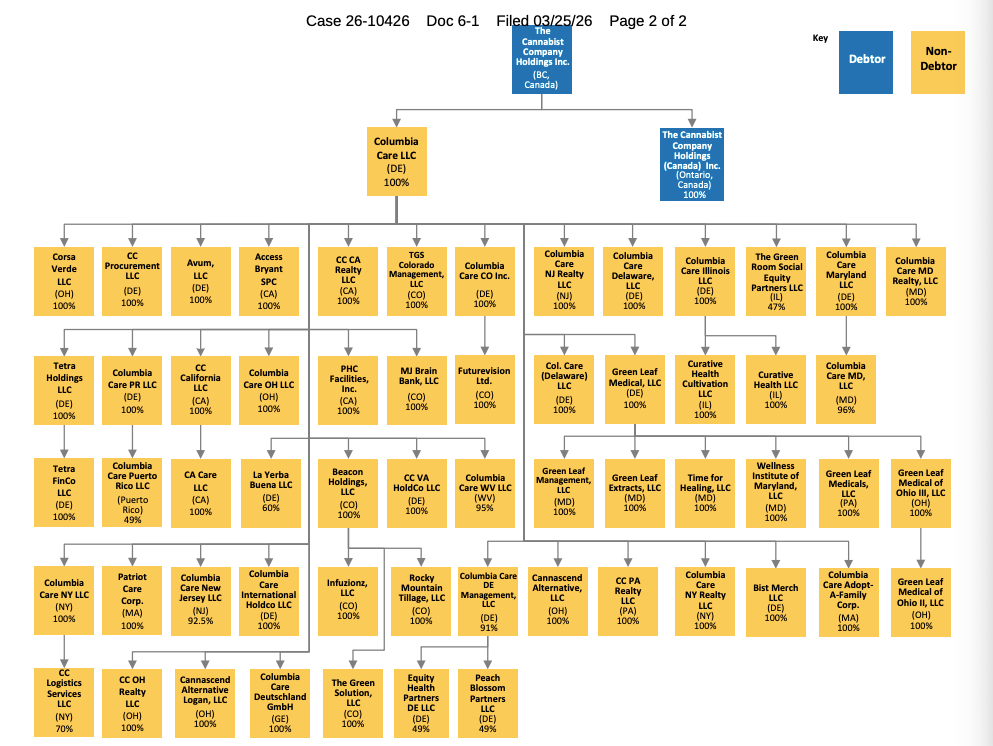
This one is a bit wonky because, as astute PETITION readers likely already know, the chapter 11 bankruptcy system is unavailable to cannabis companies and, here, the debtors’ non-debtor subsidiaries operate a vertically-integrated cannabis cultivation, manufacturing, and retail business, legally peddling medicinal and adult-use cannabis in eight states that permit such a heinous thing, 😉 (💨bong rip #2💨). Unfortunately for the CC Group, the cannabis business hasn’t exactly been lighting things up — in ‘24, the CC Group generated $200mm in revenue but lost $100mm. Whuh? Yeah bruh, gnarley. It turns out the business has faced a slate of headwinds including insane levels of competition, supply-chain stuff, and difficulty tapping capital markets.
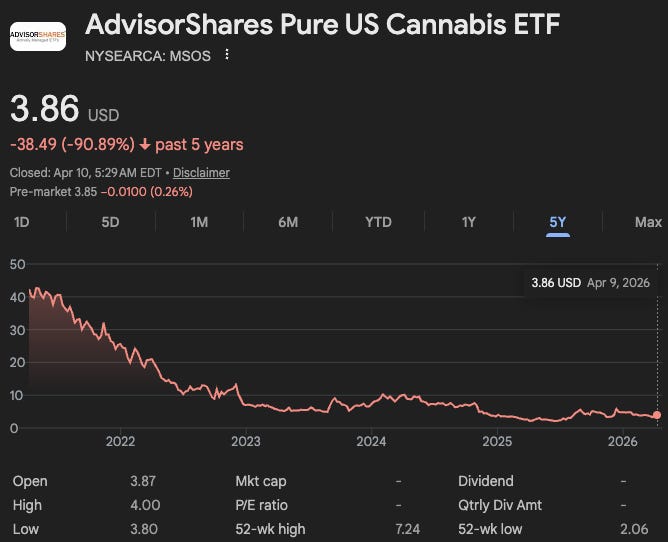
Let’s take a moment to pause there. Anyone remember the irrational exuberance surrounding cannabis stocks during the pandemic? We sure AF do. It looks something like this 👇:
Or, zooming in, this 👇:
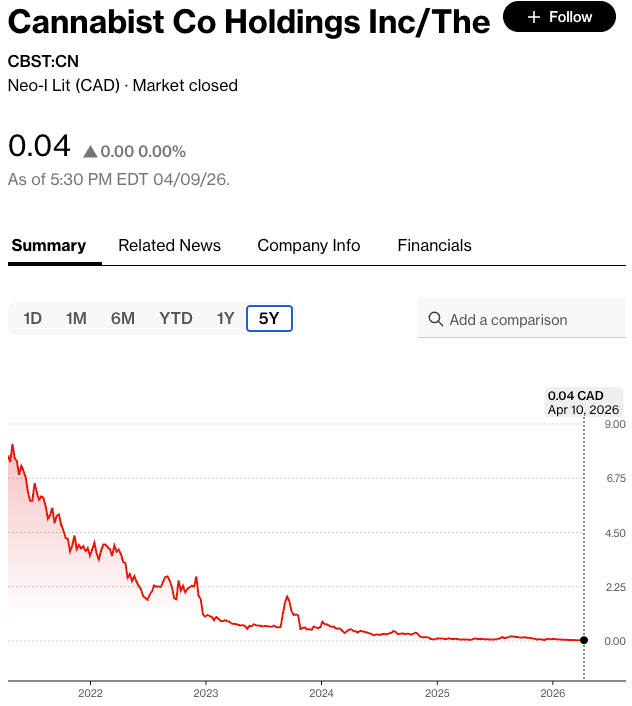
If you happened to be sitting at home, sequestering yourself from the kids and day trading back in ‘21 only to RTO and forget about your PA, you’re looking at one hell of a decline for any of your cannabis stocks. ‘21 was euphoric, marked largely by hopes that the Biden administration and a Democratic Congress would federally legalize cannabis. But momentum stalled post-pandemic and attempts at federal reform, i.e., the SAFE Banking Act, failed, compounding existing structural issues like the effect of Section 280E of the Internal Revenue Code (“280E”) and oversupply in North America broadly. While the focus then shifted to “rescheduling” cannabis to a lower and more widely-accepted and available classification, that hasn’t happened either. Gosh, if only there was something we could do with all of that over-supply to deal with disappointment after disappointment, 🤔, (💨bong rip #3💨).
Anyway, here we are. Before the filing of both the CCAA and chapter 15, the debtors, with the assistance of investment banker, Moelis & Company ($MC), commenced a lender-supported sale process that will ultimately culminate in a CCAA Plan of Compromise and Arrangement and provide for the distribution of sale proceeds and liquidation of the remaining carcass. Again, to be clear, the non-debtor subsidiaries in the business of selling cannabis product aren’t involved in the chapter 15 per se; but the equity and assets of certain of those entities will be sold as part of the MC sale process, with others being wound down.
Which begs a question: what will the sale process bring to bear? Notably, the CC Group’s capital structure includes $220mm in funded debt. That figure is comprised of (i) $166.2mm of 9.25% ‘28 senior secured notes (which were pricing at 53.5c on the dollar as of March 30, 2026), (ii) $12.7mm of 9% senior secured converts,* and (iii) $40.4mm of mortgage debt secured, obviously, by real property. In addition, there are basic unsecured obligations, some lease obligations (many of which are guaranteed by CBST), and some $51mm or thereabouts in disputed tax liabilities emanating out of the US Internal Revenue Service’s (“IRS”) 280E-based position relating to the CBST’s application of deductions or credits (more on this 👇).
The good news is that MC has already closed on three transactions and, at the time of filing, had an additional pair signed up. The proceeds for all are not disclosed but quick napkin math of those that are adds up to … hang on, carrying numbers ain’t Johnny’s strong suit … $194.5mm so far. But wait, there’s more. CBST also entered into non-binding MOUs with respect to the sale of its businesses in six other states prior to the filing of the CCAA. Not too shibby. We mean, shabby (💨bong rip #4💨).

While MC has been working its magic, the specter of the IRS lingers. After the IRS filed a federal tax lien with respect to the 280E dispute, CBST agreed to a $500k/month payment plan in exchange for the IRS releasing its lien. Ultimately, however, CBST failed to keep up with said plan and the IRS issued a notice of levy on certain accounts in CBST’s name. Per CRO Curt Kroll of SierraConstellation Partners LLC, CBST filed the CCAA and the chapter 15 with the concern that if CBST continues to fail to make the monthly payments, the IRS will attempt to levy and subsequently garnish bank accounts. Consequently, the debtors sought immediate provisional relief seeking recognition of the CCAA and the “Initial Order” issued therein, staying actions by, among others, the IRS and other US-based creditors against the entire CC Group, which, again, includes non-debtors (see Docket 5).
At a first day hearing held on March 26, 2026, the debtors and their counsel blew an epic opportunity to break new ground in a bankruptcy court. And, no, we’re not talking about that request for provisional relief. Cue the tape, Johnny:
Zach Shapiro of Richards Layton & Finger: Good morning. For the record, Zach Shapiro of Richards, Layton & Finger. I am here today on behalf of the foreign representative. I’ll be very brief before I turn over the podium. First, I wanted to thank Your Honor for scheduling this hearing.
Judge Shannon: Happy to oblige.
Zach Shapiro: Second, the last time I was here before Your Honor, your chambers assisted me with organizing an ear-piercing presentation [a reference to the unrelenting shenanigans of Kirkland & Ellis LLP’s Joshua Sussberg in the Claire’s chapter 11 case].**
Judge Shannon: I’m really looking forward to what it is you brought in today.
Zach Shapiro: I wanted to assure Your Honor there will be no presentation like that today.
Judge Shannon: Well then this hearing’s over! (Laughter)
Judge Shannon already hitting a 🎯. We have so many questions:
📍How is it that Mr. Shapiro and his buds (😉) over at Weil Gotshal & Manges LLP (Garrett Fail, David J. Cohen, Alexander Cohen, Andrew Clark, and the appropriately named Robert Niles-Weed) failed to seize the best and likely only ever opportunity to engage in a blaze-fest with a bankruptcy judge (💨bong rip #6💨)?!
📍How do you understand a cannabis company and a cannabis case without, like, being on cannabis (💨bong rip #7💨)?!?
📍In an ongoing war of attrition among the major biglaw RX shops, how the f*ck do you forgo such a glorious opportunity to out-schtick the King of Schtick himself, Mr. Sussberg (💨bong rip #8💨)?!?
Seriously, an ear piercing is one thing but there’s no way that dude will ever crush the wacky tobaccky … the goof butt … the stinkweed … in a courtroom ... zero chance.

📍Are we crazy to even suggest this as an opportunity?
You be the … gulp … judge … back to the tape Johnny:
Judge Shannon: And you had about 1,200 employees. Is that spread across Canada and the United States?
David Cohen: Correct. It’s, yeah, mostly in the United States, where about 1,200 employees. So yeah, this is a significant company and we’ve sold assets off in the last few years. But even still today, we have over 1,200 employees. We have 72 licenses to legally operate retail stores and cultivation facilities. There’s still 54 retail stores, 15 manufacturing and cultivation facilities. Really because this is confined within each state, so each state has its own. And in fact, right here in Delaware, the Delaware subsidiaries own three Columbia Care branded retail stores. There’s one in Rehoboth Beach, one in, I think it’s Smyrna, I’m probably botching that pronunciation, Smyrna, and then one about 15 minutes away from here in Wilmington on Concord Pike.
Judge Shannon: Where on Concord Pike? [Laughter]
David Cohen: I think it’s the Brandywine Shopping Center.
Judge Shannon: I know exactly where that is.
We bet you do, Judge, we bet you do (💨bong rip #9💨).

Anyway, damn it, we’ll spare you continued discussion of this because all we actually got really was a pretty standard hearing. Sure, the United States Trustee (“UST”) — as the UST is often wont to do — did try to inject some drama into the proceeding with an argument that the debtors’ requested provisional authority on behalf of the non-debtor subsidiaries is outside the bounds of the bankruptcy code (and the Purdue decision) but the Judge was in a hurry for some reason — we don’t know, maybe an errand needed to be run over to Concord Pike, 🤷♀️ — quickly dismissed the UST’s argument, and approved the provisional authority. An order hit the docket that same day.
A hearing for recognition is scheduled for May 12, 2026 at 2pm ET.
The debtors are represented by, as noted above, Weil, Richards Layton & Finger PA and MC; they also have Stikeman Elliot LLP (Lee Nicholson, Brittney Ketwaroo) as Canadian counsel. The CCAA Monitor is FTI Consulting Canada Inc. ($FCN), which is represented by Morris Nichols Arsht & Tunnell LLP (Derek Abbott, Alexis Sullivan) and Torys LLP (Scott Bomhof, Adam Slavens). The ad hoc group of noteholders in support of the debtors’ proposed course of action in these CCAA and chapter 15 proceedings is represented by Feuerstein Kulick LLP (David Feuerstein, Samantha Gleit), ArentFox Schiff LLP (George Angelich) and Young Conaway Stargatt & Taylor LLP (Sean Beach, Matthew Lunn, Eric Lovetri) as legal counsel and Ducera Partners LLC as financial advisor. Smoke em’ if you got em’.
*Notably, this capital structure is the direct result of a prior balance sheet transaction that took place pursuant to a Canadian CBCA in ‘25, effectively lowering the amount of funded debt by tens of millions of dollars. To no avail … obviously.
**It’s, frankly, amazing that Kirkland & Ellis LLP put this up on its website.
⚡Update: Zynex, Inc. ($ZYXIQ)⚡

Back in December ‘25, electro-therapy device company Zynex, Inc. ($ZYXIQ) and six affiliates (collectively, the “debtors”) filed chapter 11 bankruptcy cases in the Southern District of Texas (Judge Perez). We covered the filings in January ‘26 here 👇 …

… and to briefly recap, the debtors found their way to bankruptcy after (i) Tricare, a government-sponsored health care program for members and veterans of the US Armed Forces, “… paused all payments and reimbursements to the Company as a result of an investigation into the Company’s historical billing practices” and (ii) getting “crushed” — CFO Vikram Bajaj’s word choice, not ours — by lawsuits alleging “… fraudulent over-billing practices …,” “… violations of federal of federal securities laws …” and the RICO Act.
AKA the too-common sh*t show gracing chapter 11 dockets these days.