

💥Another Failed LME (Cubic Corp.)?💥
Also: QVC Group Inc.'s pref group takes an "L" and lodges an appeal.

Our beloved Johnny found himself in NYC recently and opted, on a sweltering summer day, to take an MTA bus rather than suffer the Hades that is NYC’s underground subway system. As the Select-bus pulled up, a dozen people disembarked while about two score piled in. Only Johnny’s dumba$$ actually paid. Literally. So how did he pay? He tapped his iphone to San Diego-based Cubic Corporation’s (“Cubic” or the “company”) fancy touch screen and Apple Inc. ($AAPL) took care of the rest. Johnny proceeded to judgmentally look at the people to his right and left and question his life’s choices.
And Cubic’s viability.
As recently as ‘21 Cubic was a wildly successful public company with two solid business segments. First, there’s the alluded-to Cubic Transportation Systems segment, which provides fare collection services and congestion road management solutions to domestic and international transportation agencies in major urban hubs. Read: places like New York City, San Francisco, Boston … you get the idea. This accounts for roughly 60% of revenue. And, second, there’s it’s Defense segment, which provides (i) air, ground, and virtual combat readiness training systems, and (ii) data gathering, processing, and dissemination products at battlefield edges to the US military and its allies. You can do the math on revenue.
In Q1 of ‘21, Cubic found itself the target of a hyperactive private equity environment and a bidding war ensued to take the company private via leveraged buyout. Enter Veritas Capital (“Veritas”) and Elliott Investment Management (“Elliott”) which, together, sought to purchase Cubic at a large baked-in premium of $70/share (equating to a $2.8b enterprise value).
But ‘21 ‘21’d. And so of course there was another suitor.
Cue ST Engineering (“ST”), which submitted a competing $78/share proposal, precipitating Veritas/Elliott to raise their offer $5/share to $75/share. On March 31, 2021, Cubic announced that it had accepted the lower Veritas/Elliott offer — “…representing a premium of approximately 69% to Cubic’s unaffected closing stock price on September 18, 2020, the last trading day before the Company’s disclosure of third-party interest in potentially acquiring Cubic. The all-cash transaction will be valued at approximately $3.0 billion, including the assumption of debt.” Why the lower bid? Per the announcement, “[t]he Board determined that, based on the superior certainty and anticipated timing of closing the existing transaction with Veritas and Evergreen, the revised proposal from Veritas and Evergreen was in the best interests of all Cubic’s shareholders.” The transaction closed on May 25, 2021 and the company emerged from the deal with a healthy $2.5b of debt (under the moniker Atlas CC Acquisition Corp.). Fitch Ratings immediately threw a yellow card — sorry, we’re still basking in World Cup glory — indicating that the company’s gross leverage post-transaction was high for its assigned ‘B’ rating at 6x.
Fast forward to last summer and that debt came home to roost. In July ‘25, Bloomberg reported that Veritas, Elliott, and the company’s other lenders had engaged in some … well … let’s play a game:

Per Bloomberg:
“As part of the transaction, holders of Cubic’s roughly $1.4 billion term loan B due 2028 will exchange their debt at par for a new first-lien loan that matures a year later, and will also provided new financing, according to people with knowledge of the terms. The deal reconfigures the loan’s repayment order to include new second-out and third-out priorities.
Holders of the company’s roughly $300 million term loan C also due 2028 will swap into a new loan due a year later at about 70 cents on the dollar, said the people, who asked not to be identified because they’re not authorized to speak publicly. Interest on that loan will partially be paid via new debt, the people added.”
For their part, Veritas and Elliott chipped in too; they provided $170mm of common equity as part of the deal. In total, the deal amounted to $275mm of fresh capital plus $200mm of interest reduction and $370mm of deleveraging (by way of discount capture and pref exchange). What sparked the need? Bloomberg added that the company’s rev gen “…faced delays transitioning transportation contracts to the more profitable operations and maintenance stage.”
On the heals of that transaction, S&P Global (“S&P”) chimed in, upgrading Atlas CC Holding LLC from SD to CCC+ with an “outlook negative” stamp. S&P housed doubts, however. In its “rating action overview,” it indicated that it expected piss poor recoveries across the cap stack in the event of a payment default — from the company’s second-out facilities due May ‘29, which includes a $1.4b 1L TLB, a $203mm PIK TLC and a $85mm PIK TL, to the company’s third-out $164mm 2L TL (due August ‘29). Those facilities sit behind first out facilities in the form of a $225mm RCF and a $325mm LC.
It also highlighted (with numerous caveats related to information gaps, transparency, and accounting addback chicanery) how the company is a cash-incineration machine with uncertain business prospects marked by meaningful execution risk. S&P added:
“Cubic ’s new required incremental reporting to lenders may improve transparency . Under the new credit agreement, the company now must report additional information about its quarterly performance to lenders, including segment-level financial performance, backlogs, penal sum of surety bonds, letters of credit outstanding, and summary management discussion and analysis. It also must include a live question-and-answer session during quarterly calls with lenders. We believe these requirements are a positive development that could help stakeholders better understand the business and make more informed decisions. We think management’s lack of transparency has led to some loss of confidence in its financial statements regarding Cubic’s performance, financial position, and cash flow generation.” (emphasis in original)
It didn’t take long for the company to validate S&P’s concerns and for cracks to (re-)emerge.
Here’s a snapshot of the company’s $1.4b 1L TLB due May ‘29 and its $200mm PIK TLC from November to mid-January ‘25.
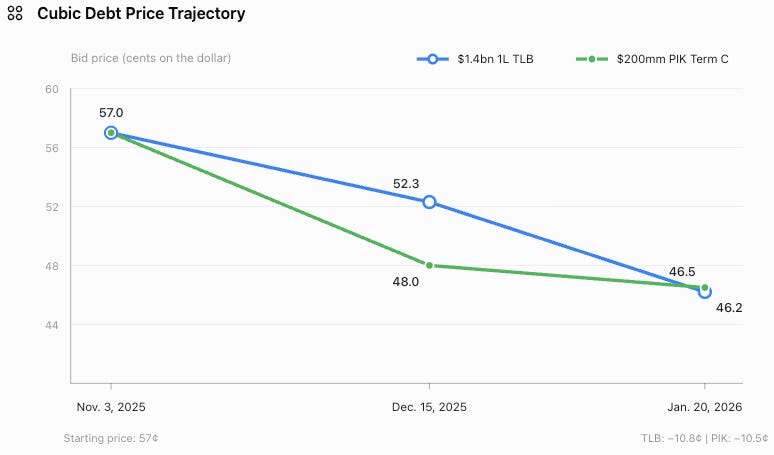
That’s when sh*t really hit the fan.
⚡️ANNOUNCEMENT⚡️
Did that 👆article abruptly end at “That’s when sh*t really hit the fan”?
Not for paying supporters/subscribers.
To get past our paywall, see full articles, and get our robust a$$-kicking paying-subscriber-only Sunday edition, please become a paid subscriber.
We do offer group trials/subscriptions: petition@petition11.com.
💥QVC: ‘C’ for Conclusion?💥

We’ve previously covered the chapter 11 bankruptcy cases of QVC Group Inc. (“QVCG”) and its 73 debtor subsidiaries here, here, here, here, here, here and, lastly, here:

We’d recap but if you hadn’t been following this situation after that much 👆coverage, let’s be honest: you’re likely irredeemable. Suffice it to say, the entire case basically boiled down like this 👇:
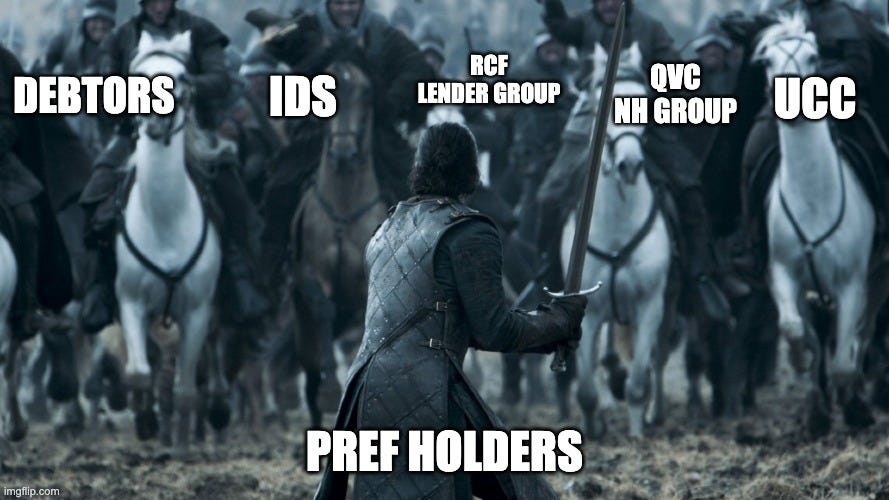
And so on June 4, 2026, the various parties got before Judge Perez of the Southern District of Texas and started to argue their case: that is, for the prefs, that confirmation of the debtors’ proposed plan of reorganization should not be granted and exclusivity vis-a-vis the topco QVCG should be terminated; and, as for the debtors and everyone else by their side, that confirmation ought to be granted and that the prefs … which at the time were pricing in this elevated range 👇 …
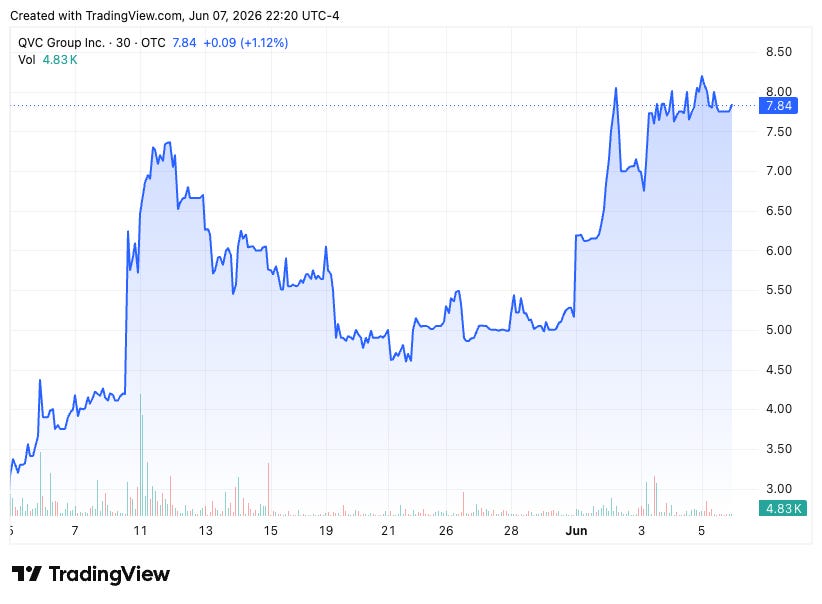
… be sent packing.
The festivities kicked off with bankruptcy-MC-extraordinaire, Kirkland & Ellis LLP’s (“K&E”) Joshua Sussberg, keeping the schtick to a bare minimum over the course of a “brief” 20-minute-long opening statement powered by a lean eight-page Powerpoint presentation. The most relevant slide is this one:
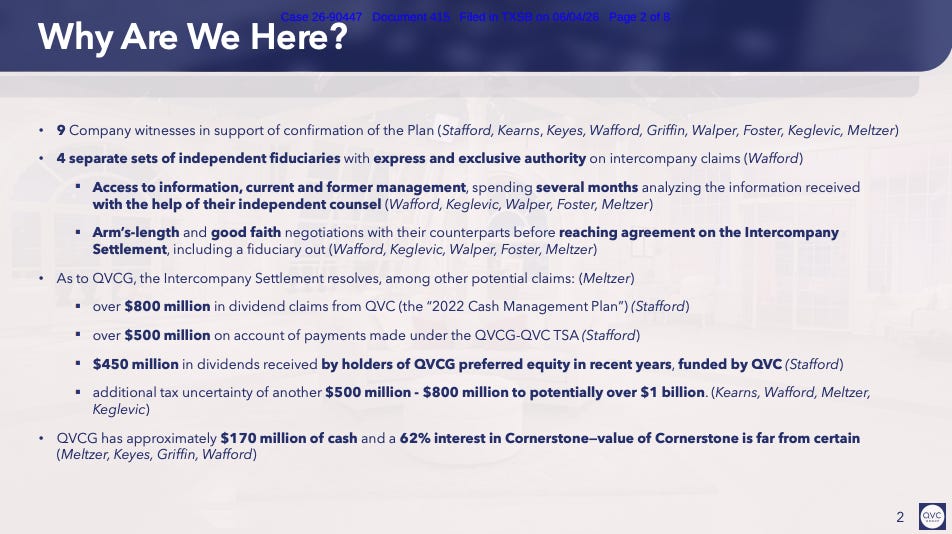
We’ll try to sum up his statement in less than 20 minutes. These were the high points:
📍K&E has a “tracking list” (no sh*t!!) and homeboy has hussle. Once he realized that JCPenney’s former CFO, Bill Wofford, became CFO of QVCG, Mr. Sussberg reached out to see if he can be of assistance. He, however, was not alone. Apparently the pref group’s financial advisor, Andrew Scruton of FTI Consulting Inc. ($FCN), also reached out at the time to offer up advisory services. Cool gossip, bro, but is this indicative of anything more? According to Mr. Sussberg, the self-serving outreach speaks to the company’s troubles which, in turn, speaks to the large possibility of insolvency, which, in turn, speaks to whether inter-company fraudulent conveyance actions might’ve been in play which, in turn, speaks to the necessity of the settlement that served as the cornerstone of the debtors’ proposed plan and the source of the prefs’ ire. If that reads as something a bit “thin” on its own, you’re not crazy. The fact that professionals reached out is hardly dispositive of solvency or insolvency. We mean … sheeeeeeeyit … RX pros are currently reaching out to management teams that have nearest-term maturities in 2037 (all ❤️, Scott, don’t @ us).
📍Mr. Sussberg then sh*t all over the notion that fraudulent conveyance analysis would have been performed and/or disclosed in advance of bankruptcy as suggested by the 4,592,929 pages of SEC exhibits filed by the pref group. He said:
“At play during the course of confirmation will be many different intercompany claims. Now, it’s interesting because we’ve been hearing from Mr. Glenn … [n]ever before have these intercompany claims been disclosed, never. We’re attaching Qs and Ks and all sorts of information. Mr. Glenn’s brief had 600 pages of exhibits of Qs and Ks. Well, we’ve read those Qs and Ks, too. Intercompany claims, as all restructuring professionals know, arise when we get involved. They arise because we start looking at the intercompany relationships that potentially give rise to issues, complaints, and concerns that our stakeholders are going to raise. And guess what? Fraudulent transfer claims, you know when they arise? On the day you file for bankruptcy. They don’t otherwise exist. So, it would be unbelievable in our world to have companies that are solvent, insolvent, whatever it may be, hypothesize that down the road, ‘We want to make sure that you understand, if people want to argue about this, we may have a fraudulent transfer. But we’re not in bankruptcy, doesn’t exist.’’”
Therefore, the company’s December ‘22 cash management-upstreaming to QVCG, as well as $450mm in dividends actually paid our to pref holders over the prior years — it’s all subject to attack.
📍Whoa boy. Call in the tax nerds. Folks could expect (and got) all kinds of boring a$$ talk about a tax sharing agreement and whether opco and to-be-reorganized-around QVC Inc. (“QVCI”) overpaid estimated stand-alone taxes up the corporate chain over the years and whether, therefore, there was any obligation on the part of holdco QVCG to refund down any overpayment.

📍Whoa boy II. Call in the tax nerds AGAIN. There’s also some whole thing about a whole deferred tax payment at the LINTA corporate box that may give rise to a $2b IRS claim against the whole enterprise (that the debtors spent $36mm in premiums to insure against).

📍Okay, the tax nerds can sit this one out. Recall QVCG’s 62% stake in Cornerstone? Yeah, that’s worthless, so there’s no “value” being stripped from the prefs. Per Mr. Sussberg:
“Cornerstone is owned 62% by the holding company and 38% by LINTA, that other box. The LINTA box wanted nothing to do with Cornerstone. Uh, the business was pulled out of our credit facility because it was a drag on overall performance, and we miraculously convinced QVC Inc. to continue operating that business. If Cornerstone’s not operated by QVC Inc., the operating company, the synergies that are realized at that business from a UPS shipping standpoint disappear. There is no more Cornerstone if it’s not operated by QVC Inc. So, you can’t just cavalierly say, ‘We’re going to go market our 62% interest in Cornerstone and see who buys it.’ I can tell you, I would buy it for the $2 bill that Mr. Riesman gave me last night. That’s what it’s worth.”
LOL, the cameo by Mr. Riesman’s (in)famous two dollar bills.
📍Then a customary nod to the boxes’ separate governance. Obviously the debtors relied on a lot of cross-debtor professional advice … something the prefs attacked. There was no other financially realistic way for these cases to be administered.
Anyway, here was a live shot of Glenn Agre Bergman & Fuentes’ Andrew Glenn, counsel to the pref group, during the “brief” opening:

Before standing up and putting everyone to sleep by diving straight into his deck, where he made these points:
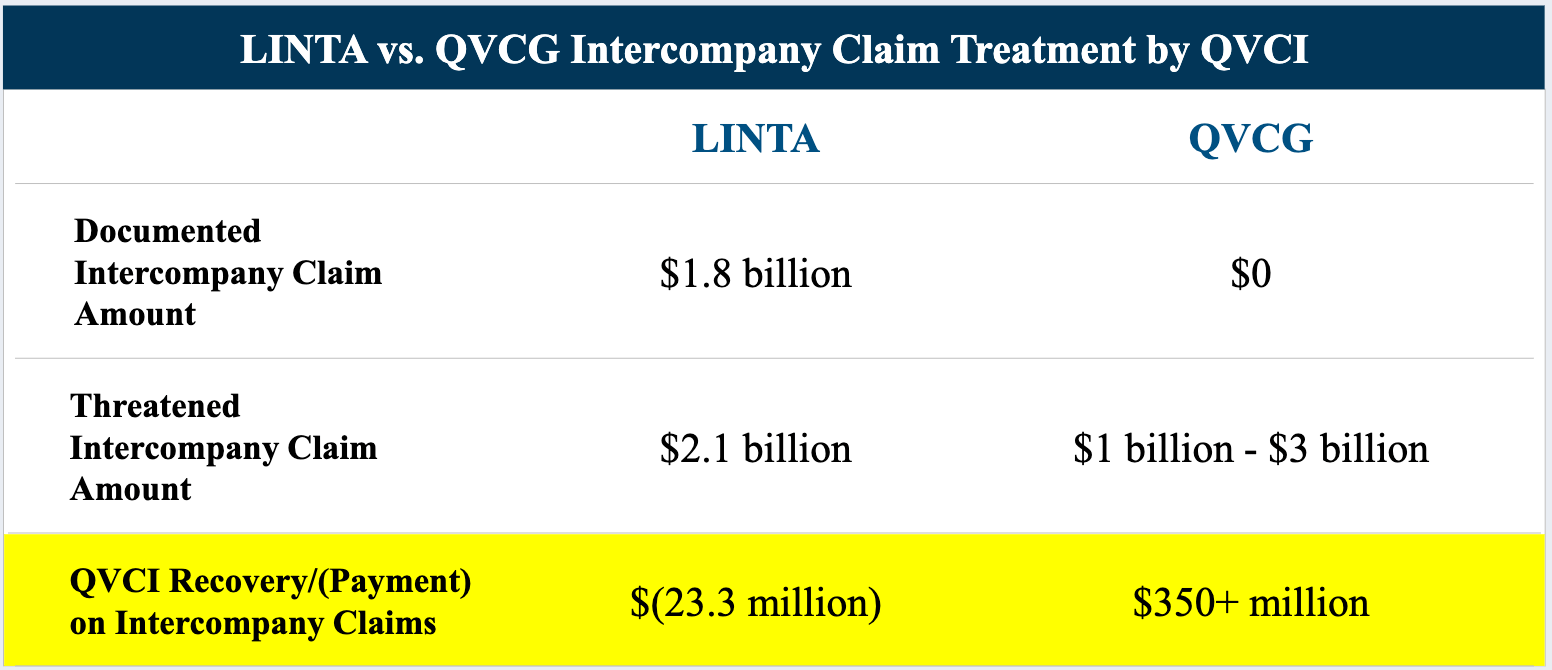
📍QVCI and therefore its creditors are making out like f*cking bandits. In fact, they’re getting more than 100% of what’d they have gotten in a litigation because there, of course, is no litigation. Which Mr. Glenn asserts is “… a complete capitulation” and unlike every other settlement in the cases, like, we dunno, this one 👇:
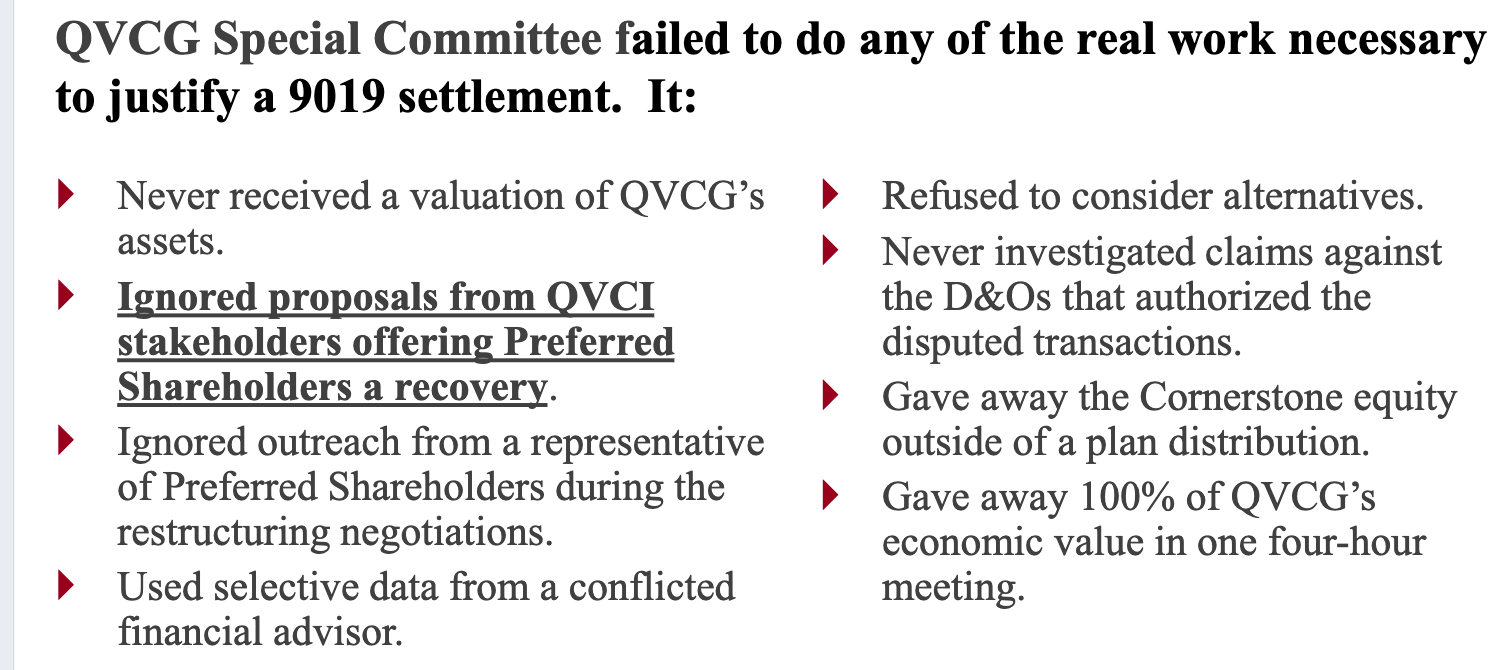
📍Moreover, QVCG funded ~$90mm in restructuring expenses, basically all of which was for insolvent subsidiaries, not itself. Another knock on its management, which to Mr. Glenn has a real sh*t track record:
📍Oh, and that upstreaming? Yeah, the fraudulent transfer concerns are BS, not real; Duff & Phelps provided a a$$load of solvency opinions along the way.
📍A better alternative exists! Terminate exclusivity, as the pref group asked for, and litigate the claims, as the pref group was willing to fund. Heck, they’ll even pay for their share of the tax insurance. Tax claims, trade, etc. at QVCG gets paid in full.
Anyway. That was all lead-up to many hours of testimony and evidence, which spanned four days, which, as we alluded to above, had many boring moments but a good portion of which was dedicated to sh*tting on QVCG’s “independent” board member Roger Meltzer, who, as far as Mr. Glenn could tell, was just there to clip a monthly. The in-court testimony. Man. From the pref group’s closing presentation:
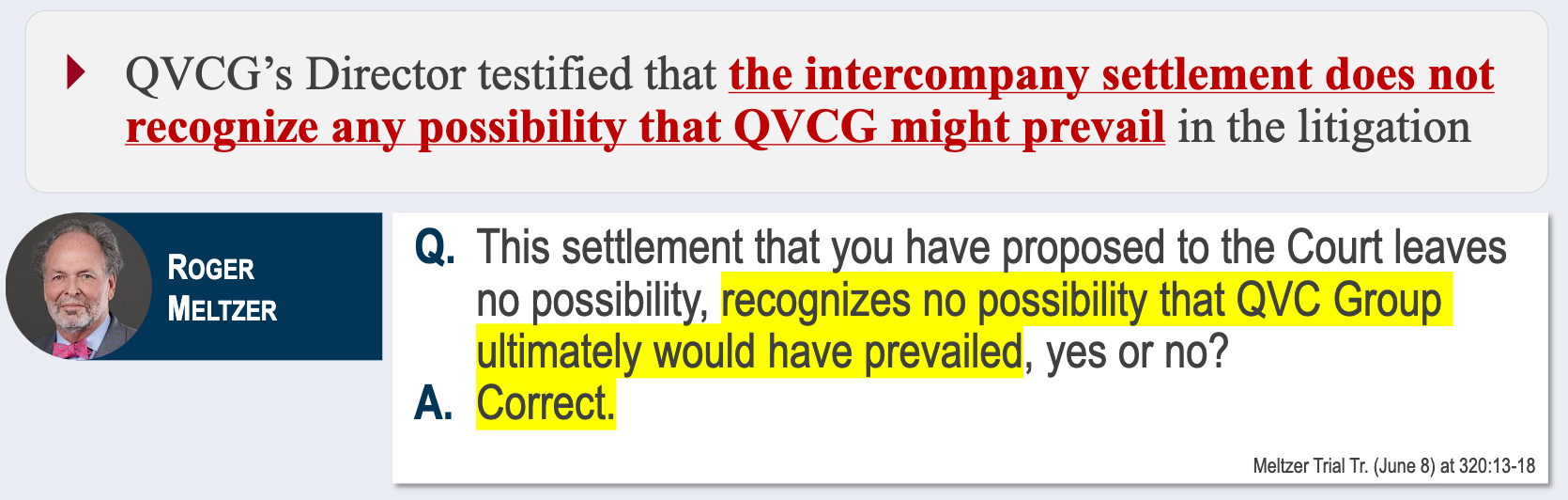
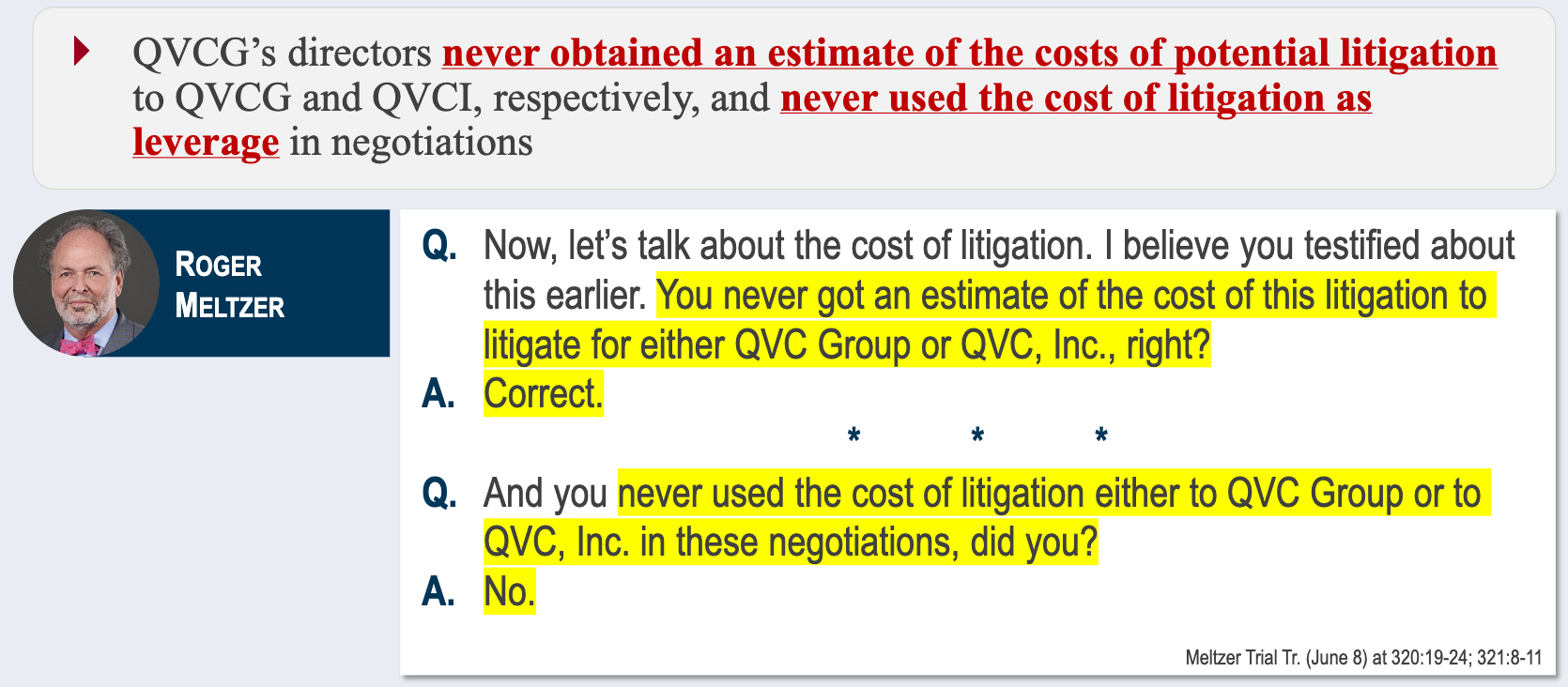
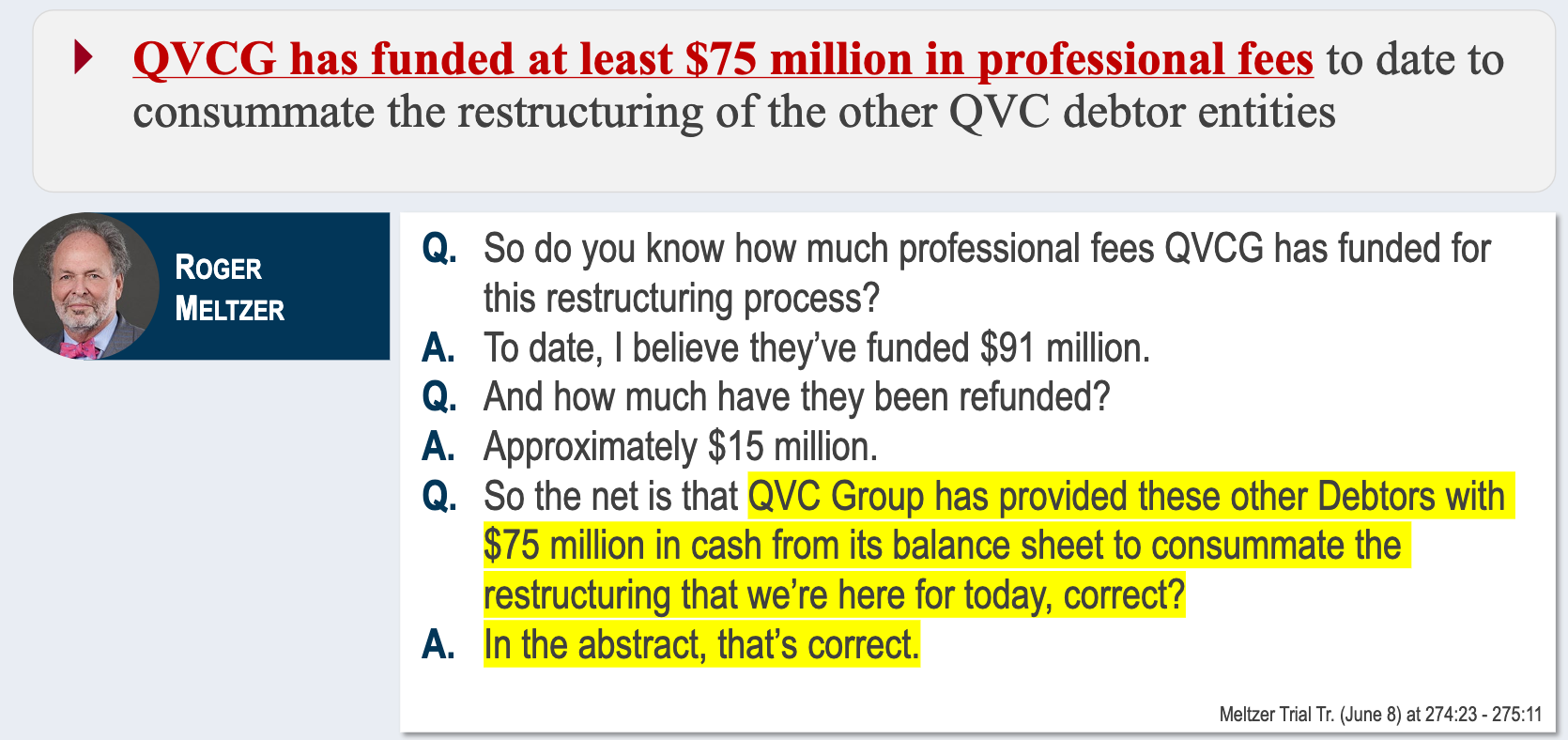
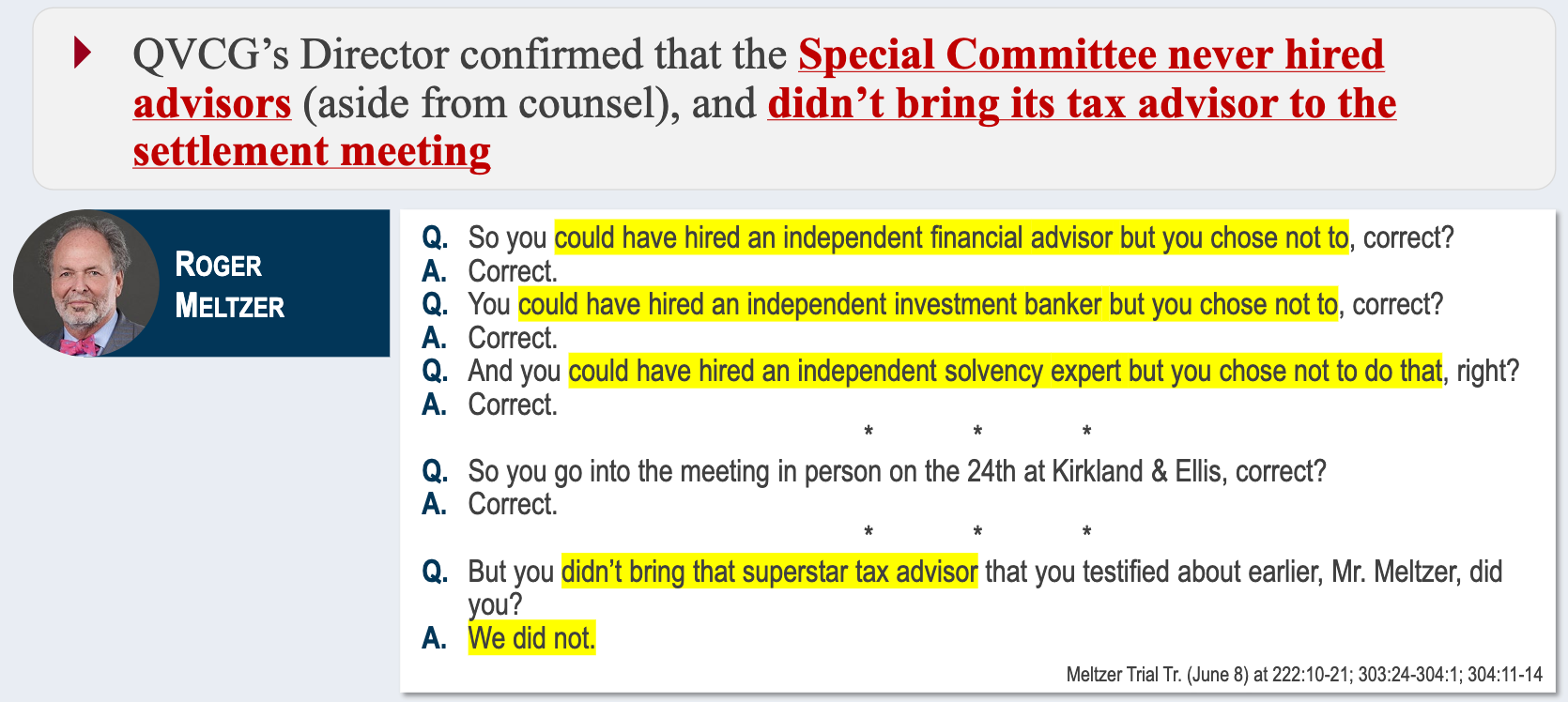
Holy hell, what a gig. $50k month-in, month-out; sign us up.
Anyway, that wrapped around June 10. Then we waited. Over a month.

With the benefit of hindsight, we know why. On July 15, 2026, Judge Perez ruled and, notwithstanding those, um, glaring deficiencies, approved the settlement and confirmed the debtors’ plan. Over 103-pages.* You know, gotta make sure you dot your i’s and cross your t’s because we can summarize it in five words: “debtors always win in SDTX.” Which has a corollary: “outsiders lose.” In the case of the pref holders, big time.
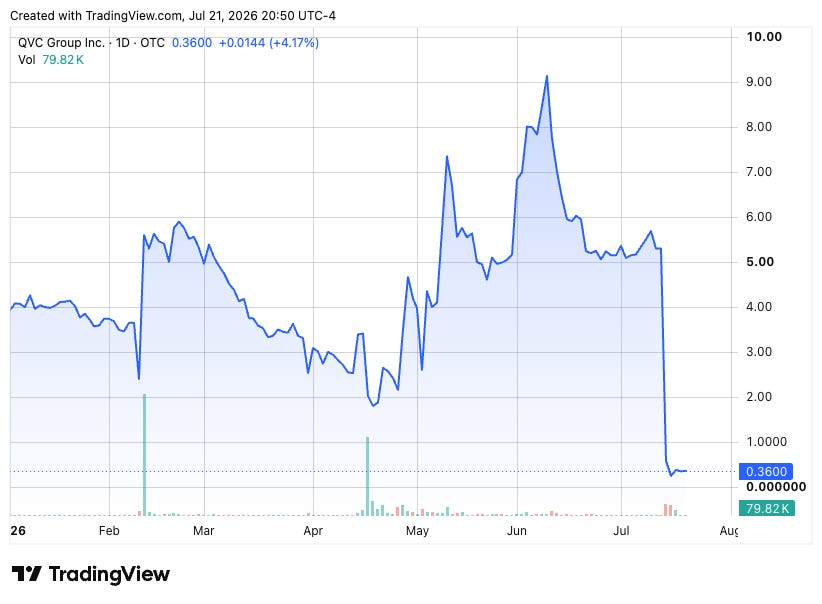
However, don’t put away your 🍿 just yet. The very next day, the pref group appealed (amended here), so we’re off to appellate review — a level of review which has caused some consternation for SDTX’s bankruptcy courts over the last couple of years. Contemporaneously, the pref group also filed an emergency motion for a stay pending their appeal of the confirmation order — their obvious fear being that the debtors will consummate the now-confirmed plan and transfer all dollars/assets out of QVCG and, consequently, argue that the pref group’s appeal is equitably moot. Here is a live shot of AlixPartners LLP’s Jason Keyes, the debtors’ financial advisor, upon getting word of the (unsurprising) emergency motion:
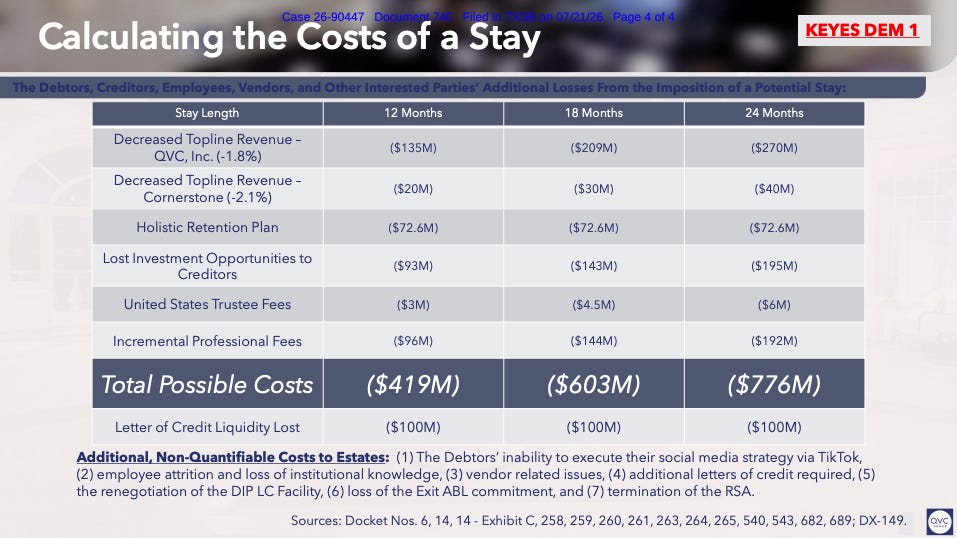
And so the debtors dropped an objection to the motion, to which Mr. Keyes slapped on a declaration of support.** Therein he delineated 12 bulletpoints to demonstrate the negative effect a stay would have on the debtors’ business. He wrote:
“In sum, the overall harm to the Debtors and their constituencies from a protracted stay in bankruptcy would be massive. Decreased topline revenue at QVC, Inc. and Cornerstone, continued fee burn, U.S. Trustee fees, lost investment opportunities for creditors, and employee retention could materialize into approximately $419 million over a 12-month stay, $603 million over an 18-month stay, and $776 million over a 24-month stay—even before taking into account the loss of a planned $100 million in additional liquidity as letters of credit would otherwise begin to expire. In addition to those quantifiable categories, other portions of the harm to the estate— such as the failure to capture a narrow window to transition to social media—are incalculable.”
Then he threw in a demonstrative for good measure:
At a tech-challenged hearing held on July 21, 2026, the pref group and the debtors argued for and against the stay, the former shouldering the heavy burden of satisfying four factors in the Fifth Circuit that inform a grant of stay pending appeal and the latter sucking up to Judge Perez and celebrating his confirmation decision. We’ll spare you (and ourselves) the specifics — mostly because Judge Perez committed to an oral ruling on the motion later this morning, July 22, 2026, at 10:30 CT.
We’re sure it’s a total jump ball 🙄.
*The court also concluded that the decision mooted the pref group’s motion to terminate exclusivity and reserved judgment on it.
**A pair of lender group joined the fun (here and here).
📚Resources📚

There’s a lot of jittery market activity out there so you’ll have to forgive us for having market dysfunction on our minds. As you know, we’ve had a long-standing list of a$$-kicking resources on the topics of restructuring, tech, finance, investing, and disruption which, in case you forgot,💥you can find here💥. We do occasionally update it and this week you’ll now find a number of titles we’ve been dabbling in related to financial bubbles/crises. Take a look and read until your heart’s discontent.
📤 Notice📤
Alex Konstantynovski (Associate) joined Loeb & Loeb LLP from White & Case LLP.
Barrett Lingle (Executive Director) joined Uzzi & Lall from White & Case LLP.
Joseph Brown (Partner) joined A&O Shearman from Davis Polk & Wardwell LLP.
Julien de Bord (Associate) joined SierraConstellation Partners LLC from Ankura Consulting Group.
Mark Pugh (Associate) joined Paul Weiss Rifkind Wharton & Garrison LLP from King Street Capital Management.
Raymond Cho (Director) joined Reflect Advisors from Alvarez & Marsal LLC.
Steven White (Vice President) joined PJT Partners LP from Houlihan Lokey Inc.
🍾Congratulations to…🍾
Akin Gump Strauss Hauer & Feld LLP (Ira Dizengoff, Philip Dublin, Meredith Lahaie, Marty Brimmage, Jr., Laura Warrick) for securing the legal mandate on behalf of the official committee of unsecured creditors in the Pacific Capital Funding Group, Inc. chapter 11 bankruptcy case.
Alvarez & Marsal North America LLC (Richard Newman) for securing the financial advisor mandate on behalf of the official committee of unsecured creditors in the Trinseo PLC chapter 11 bankruptcy cases.
Fox Rothschild LLP (Michael Sweet, Jack Praetzellis, Noah Thomas) for securing the legal mandate on behalf of the official committee of unsecured creditors in the Pacific Capital Funding Group, Inc. chapter 11 bankruptcy case.
Matt Barr for (predictably) being named Global Chair of Restructuring at Weil Gotshal & Manges LLP and thank you, thank you, thank you, for ridding us all of that absurd four co-head structure. Now that we’ve received this mercy, someone please incept the notion into AlixPartners’ leadership’s heads that their partner titles make zero f*cking sense and all will start to be right in this godforsaken world.
M3 Partners for securing the financial advisor mandate on behalf of the official committee of unsecured creditors in the Sangamo Therapeutics, Inc. chapter 11 bankruptcy case.
McDermott Will & Schulte LLP (Darren Azman, Kristin Going, Rachel Biblo Block) and Robinson & Cole LLP (Evan Lazerowitz, Rachel Jaffe Mauceri, Brya Keilson) for securing the legal mandate on behalf of the official committee of unsecured creditors in the SIMAD Holdings Ltd. chapter 11 bankruptcy cases.
Province LLC (Sanjuro Kietlinski) for securing the financial advisor mandate on behalf of the official committee of unsecured creditors in the Sleep Number Corporation chapter 11 bankruptcy cases.